



















I Prefer His Costume After It Has Been Ruined
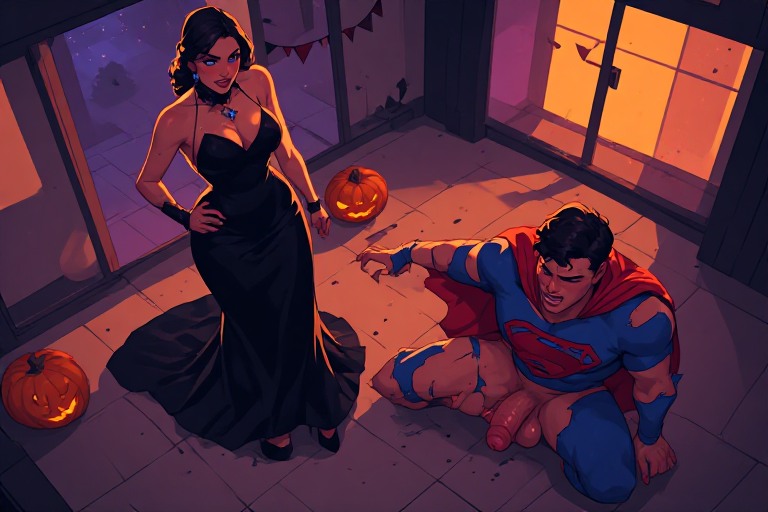
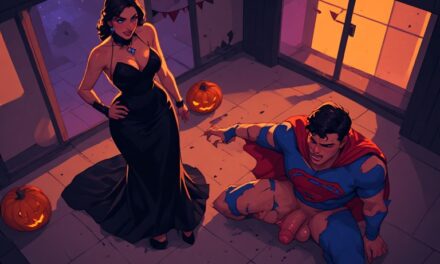
A distressed costume is an outfit whose wear, damage, and disarray become part of its character. In a consensual female-led relationship, where a woman takes the agreed leading role, that transformation can also become a shared record of the evening. Personally, I prefer a crooked collar, smeared makeup, and dirty knees to a man who still looks as though he is waiting for the shop to accept his return.
Take the pretty photograph when he arrives. Get the lighting right. Let him straighten his cuffs and explain whatever terribly clever character he has chosen. I will even give him a moment to look pleased with himself. But the photograph I want to keep is usually the one we take later, after his elaborate presentation has encountered an actual evening.
Men spend a remarkable amount of time deciding how they want to look. Halloween gives me an opportunity to discover how they behave when that appearance stops cooperating.
The Entrance Is His Advertisement
A pristine costume tells me what a man hopes I will notice. The broad shoulders. The expensive boots. The carefully applied makeup that he claims took five minutes, although I can see the tutorial still open on his phone. Every detail has been arranged to support a particular impression, and he arrives expecting that impression to survive contact with me.
Sometimes he chooses a swaggering character because confidence feels easier when someone else has already written the part. Sometimes he chooses something ridiculous and spends the first hour insisting he is only doing it for a laugh. Both approaches interest me. I want to know whether he can remain good company once the swagger slips or the joke ceases to protect him.
A costume is useful precisely because he knows it is temporary. He can experiment with being conspicuous, theatrical, elegant, or absurd. But temporary does not mean meaningless. His choices still belong to him when the wig comes off.
Give the Clothes Something to Remember
One man arrived dressed as a vampire, complete with a stiff white shirt and a cape that apparently required its own chair. He looked excellent and knew it. By the end of the party, he had carried supplies upstairs, helped retrieve a dropped earring beneath a table, and spent twenty minutes dealing with a drink somebody else had spilled.
His shirt was creased. One cuff was damp. The cape had been folded over his arm for so long that its imposing silhouette had become a tired rectangle. He asked whether he should put himself back together for a final photograph.
“Stand there,” I told him. “You finally look as though you attended.”
That was the picture I kept. His expression had changed, too. He was smiling at something happening beyond the camera instead of presenting his approved vampire face. I could see the evening in him.
Another man made the mistake of wearing an elaborate pirate coat while helping me decorate. A button caught on a chair and came away in his hand. He stared at it with the solemnity usually reserved for terrible news. I handed him a needle and thread, and his fearsome pirate spent the next fifteen minutes bent over a repair beneath a pumpkin lamp.
He looked much more interesting doing that than he had while practicing his entrance.
Smeared Makeup Has Better Timing
Fresh makeup is a plan. Smeared makeup gives the plan an ending. A painted mouth loses its sharp outline after conversation and refreshments. Dark eye makeup migrates after dancing. Glitter appears in places nobody remembers putting it, including my handbag, which I regard as the least charming form of haunting.
I remember a man who checked his reflection constantly during the first hour of a Halloween gathering. Every conversation was interrupted by a glance at a window or the black screen of his phone. Eventually, I asked him to leave the phone in his coat and help the host.
When he returned, one side of his makeup had blurred and a strand of hair had fallen out of place. He began asking whether he looked terrible, then stopped because somebody called him over to join a conversation. For the rest of the night, he scarcely checked himself.
That was the change I noticed. The makeup mattered less because the evening had finally started mattering more.
Dirty Knees Need a Story
Dirty knees are only interesting when I know how they happened. Perhaps he knelt to rescue an ornament beneath a sofa. Perhaps we spent an hour arranging lanterns along a garden path. Perhaps his grand entrance involved a theatrical bow on a floor he should have inspected first. The mark becomes worth remembering because it points to an actual moment.
I once had a costumed knight help assemble a display in a courtyard. He arrived with polished accessories and an expression suggesting he expected immediate admiration. Half an hour later, he was kneeling beside a stubborn lantern, arguing with its battery compartment while I held the instructions.
His knees collected dust. His magnificent sleeves kept sliding over his hands. When he finally got the light working, he raised it with such ridiculous triumph that I laughed hard enough to ruin my own makeup.
We took a photograph there. I would not exchange it for the perfect portrait from the beginning of the evening. The first picture showed his costume. The second showed something we had done together.
There Is a Difference Between Permission and Surprise
If I intend to alter someone’s costume deliberately, we discuss that beforehand. “This shirt can be damaged” is a useful agreement. “I assumed you would not mind” is a poor substitute, particularly when the shirt turns out to be borrowed, expensive, or attached to a memory I know nothing about.
Cheap costume pieces give us room to be playful. Removable accessories, washable makeup, and an outfit chosen with wear in mind let a man relax into the evening. He can stop worrying about preserving every detail because we have already decided what matters.
And I do not confuse an uncomfortable man with a convincing photograph. If a broken fastening leaves something he wants covered, we fix it. If a shoe starts hurting, the shoe comes off. I enjoy watching a polished presentation unravel, but I expect him to remain able to speak plainly about what he needs.
A woman can be exacting without becoming careless. Frankly, I find competence much more impressive than someone making a mess and calling it authority.
Do Not Manufacture the Evidence
There is something faintly embarrassing about staging a supposedly wild aftermath before anything has happened. The artfully torn sleeve. The precisely placed smear. The man instructed to look exhausted while everybody adjusts the lighting. You can produce an excellent photograph that way, but you cannot make it a memory.
I would rather let the evening leave its own marks. Give him something useful to do. Let him dance, laugh, carry, repair, and participate. Let the outfit become inconvenient in ordinary ways. Observe whether he complains about every crease or discovers that he can enjoy himself without maintaining a perfect silhouette.
The details that survive are often small. A bent paper crown. A stocking snagged on a rough chair. A missing decorative button found in my pocket the following morning. None of them requires an extravagant story. Sometimes a ridiculous little object can recall an entire room.
Keep the Picture That Happened
I still take the arrival photograph. I like beautiful clothes, good makeup, and a man who has made an effort for me. But later, when the collar has shifted and the careful expression has disappeared, I take another. That is usually where I find the person I spent the evening with.
Give me the vampire carrying the rubbish out, the pirate repairing his coat, the knight kneeling beside a battery-operated lantern. Let him look slightly disreputable and thoroughly involved. His costume has finally acquired a history, and that is when I start finding it worth keeping.
FAQ
What is a distressed Halloween costume?
A distressed costume incorporates visible wear, such as creases, smudged makeup, missing decorative pieces, or frayed fabric. Those details can be designed in advance or develop naturally during the evening.
Why can an imperfect costume make a better photograph?
Signs of wear can connect a photograph to particular events and shared memories. A later photograph may also capture a more relaxed expression than a carefully posed arrival portrait.
Should intentional costume damage be agreed beforehand?
Yes. Discuss which garments and accessories may be altered, especially if anything is borrowed, valuable, or sentimental. Clear agreement makes playful changes easier to enjoy.
Does the costume need to be torn?
No. A shifted collar, loosened hairstyle, creased shirt, or faded makeup can convey the passage of an evening without damaging clothing.
What makes an aftermath photograph meaningful?
Its connection to something that actually happened. The photograph becomes more personal when its details recall a conversation, mishap, task, or moment of shared amusement.












As someone who has never been to a dominatrix but fantasizes about it non-stop, I had a lot of conflicting…
The emphasis on physical closeness here really hits the mark. A lot of discussions around OTK focus purely on the…
Something like this happened to me once. My partner tied me naked to a chair in the middle of a…
All subby boys should continually hone their locution for the submissive tone that best suits their domme. In most cases,…
Thanks Thanuj ! I will definitely keep You in the Loop, It’s been a lot !