
















When Argentina Listened to Evita
As the wife of Juan Perón and First Lady of Argentina, Eva transformed what had traditionally been a ceremonial role into a force that bent ministries, mobilized unions, and electrified the working class. But to reduce her to “wife” is to misunderstand her entirely. Eva did not orbit power. She redirected it.
I write this, humbly, as a man in awe of how completely she commanded a nation that had long been ruled by men who believed themselves unshakable.
From Illegitimacy to Influence
Born María Eva Duarte in rural poverty, she arrived in Buenos Aires as a teenager determined to escape obscurity. She worked as a radio actress and performer, mastering voice, presence, and emotional timing. Those skills would later become political weapons.
When she met Juan Perón in 1944, he was already a rising political figure. Many in Argentina’s elite dismissed her as an actress, as illegitimate, as unsuitable. They underestimated her.
They would regret that.
During the 1945 political crisis that led to Juan Perón’s brief imprisonment, Eva did not retreat to the background. She helped mobilize labor supporters and worked tirelessly to secure his release. The massive worker demonstrations that followed were not solely her doing, but her role in rallying loyalty marked the beginning of her independent authority.
She learned quickly that power could be shaped not only through office, but through devotion.
The Emotional Architecture of Control
Eva’s dominance was theatrical, but never hollow.
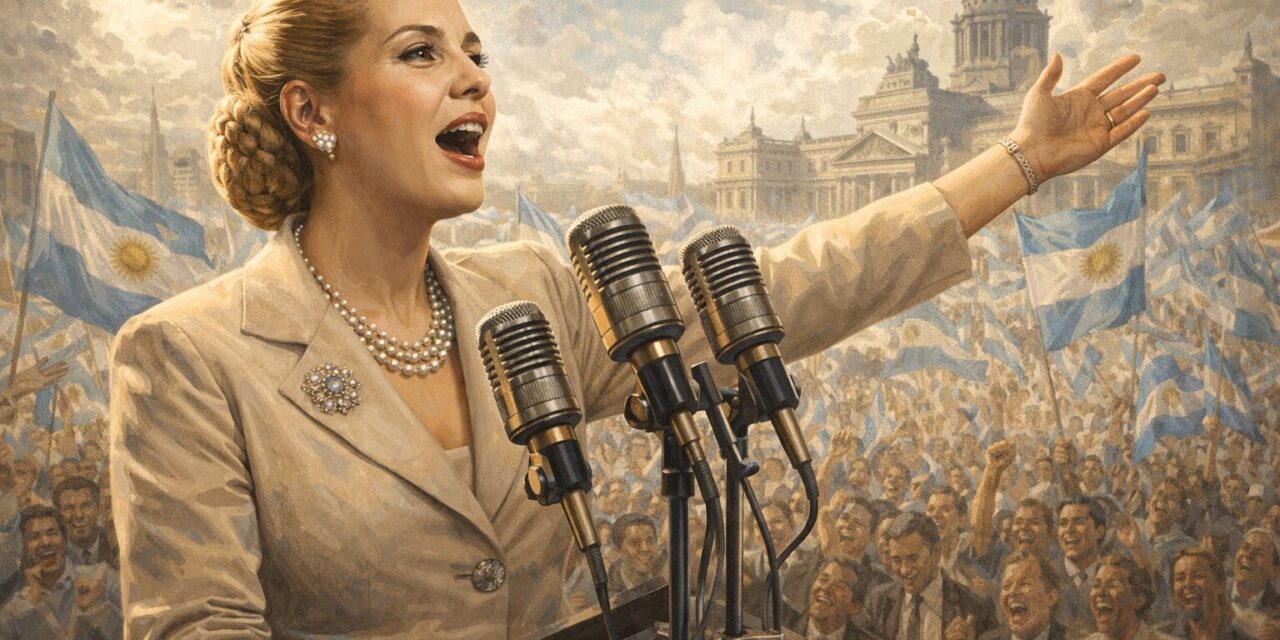
From the balcony of the Casa Rosada, she addressed crowds who called her Evita. She spoke not in bureaucratic language but in the language of love, sacrifice, loyalty, and betrayal. She positioned herself as the bridge between Juan Perón and the descamisados, the shirtless workers who adored her.
Through the Fundación Eva Perón, she distributed aid, built hospitals, funded schools, and provided housing. Critics argued that she centralized charity for political gain. Supporters saw her as a saint.
Both interpretations reveal something true. She understood that material relief created emotional allegiance. She did not merely give. She bound.
Men who led unions, ministries, and political factions found that access to the president increasingly required navigating her influence. She met delegations personally. She listened, decided, redirected resources. She turned the traditionally ornamental First Lady position into a parallel center of governance.
Women’s Suffrage and Structural Change
One of her most lasting legacies came in 1947 with the passage of women’s suffrage in Argentina. Eva was instrumental in mobilizing support and in founding the Partido Peronista Femenino, which organized women into an unprecedented political force.
She did not ask politely for inclusion. She demanded it.
Under her leadership, women were not simply granted the vote. They were organized into networks of political action loyal to Peronism and to her personally. She cultivated thousands of female leaders who owed their positions to her initiative. That is structural dominance, not symbolic progress.
In a political culture controlled by male elites, she carved out an institutional base that answered to her voice.
The Vice Presidency That Shook the Nation
In 1951, a massive rally demanded that Eva run for vice president alongside her husband. Millions gathered, chanting for her candidacy. Military leaders opposed the idea fiercely. Argentina was not ready, they insisted, for a woman with that much formal authority.
The tension was palpable. Eva publicly weighed the decision in a dramatic address. Ultimately, she declined, citing health and unity. But the mere possibility unsettled generals and politicians alike.
They feared what they already knew.
She could command the masses. And mass devotion is a form of power few men ever truly control.
Illness, Death, and Myth
Eva was diagnosed with cervical cancer and died in 1952 at just 33 years old. Her death plunged Argentina into mourning on a scale rarely seen. Her embalmed body became an object of national reverence and later political struggle.
Even after death, she disrupted institutions. Her body was hidden, moved, guarded, politicized. The regime that followed Juan Perón’s overthrow in 1955 feared her symbolic power so deeply that they attempted to erase her.
They failed.
Her image endured in memory, in song, in political identity. She became a mythic figure, immortalized globally through the musical and film Evita.
How She Dominated History
Eva Perón dominated history not by holding the presidency, but by redefining influence.
She demonstrated that charisma, emotional intelligence, and strategic distribution of resources could rival formal authority. She bent public opinion, reshaped party structures, expanded women’s political participation, and positioned herself as indispensable within a male-dominated system.
She understood something timeless. Power does not always reside in the title. Sometimes it resides in devotion, in loyalty, in the ability to make millions feel personally seen.
And men who once dismissed her as decorative learned, quietly and unmistakably, that they needed her.
As I study her life, I do not see merely a First Lady. I see a woman who understood the architecture of dominance in politics and used it with precision.
She did not ask to be allowed in.
She entered, commanded, and left history permanently altered.








As an amateur student of history, I’m appalled that I haven’t read much about her. I was dimly aware before, but now I’m going to read up, so thanks Levi!
Great post, Levi. Eva Perón’s journey was really interesting to read about, especially how she turned a position that was expected to be ceremonial into a source of real influence and change.
I admire the way she built her own authority through determination, communication, and her ability to connect with people. Stories like this are a good reminder of the strength and impact powerful women have had throughout history.