

























Ball Busting as Masculinity Control
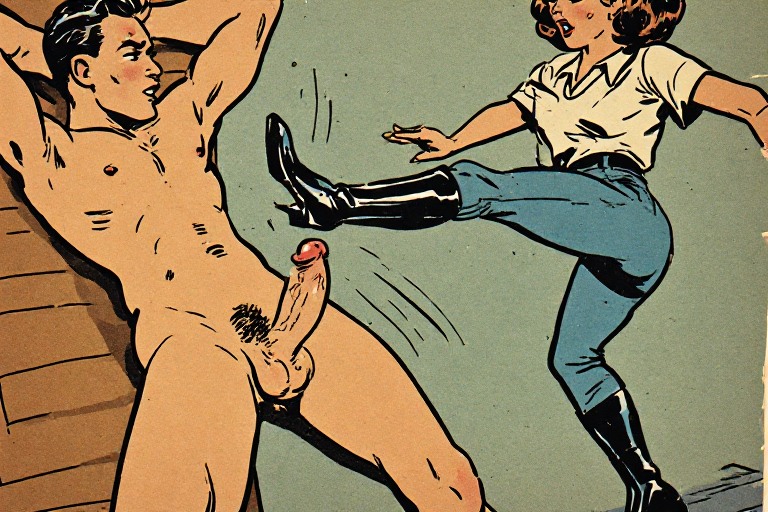
Why Impact to the Testicles Carries Such Psychological Weight
Within BDSM, ball busting refers to the consensual striking, squeezing, or otherwise impacting of the testicles as part of a negotiated power exchange. While many people immediately think of it as simply another pain activity, experienced Dominants understand there is far more happening psychologically than physically. The testicles have long been associated with masculinity, fertility, strength, and ego. When a submissive willingly places such a vulnerable part of himself under a woman’s authority, the act often becomes less about pain and more about surrender. Used responsibly, ball busting can symbolize a temporary transfer of power over one of the most psychologically significant parts of the male body.
It is also one of the most misunderstood activities in BDSM. Popular media often portrays wild kicks delivered without thought or restraint. That is neither realistic nor responsible. Good ball busting requires knowledge of anatomy, communication, restraint, and respect for the very real possibility of injury. Unlike many forms of impact play, mistakes involving the testicles can have lasting consequences.
It Isn’t Something I Use Very Often
Despite my reputation for enjoying control, this is not a technique that appears frequently in my own relationships.
With my husband Cody, occasional ball play exists because he genuinely enjoys it. His enjoyment developed over years of trust, experimentation, and learning what his body responds to. Even then, it remains only one small part of our dynamic rather than a regular event. There are countless ways to reinforce authority that involve far less risk, so I have never felt the need to rely on it.
With Ben, it has been almost the opposite experience. Only recently have I begun introducing very light ball play into some of our scenes. That introduction has been gradual, carefully negotiated, and intentionally conservative. There is no benefit to rushing into an activity simply because it looks dramatic. Every person’s body responds differently, and every submissive has a different relationship with pain, fear, and vulnerability.
The Sub Who Came for Ball Busting
Years ago I had a submissive who visited roughly once each week specifically seeking ball busting sessions. Unlike Cody, who enjoyed it as one element among many, this was the central focus of our scenes together. Working with him taught me more than any book ever could.
I learned how differently men respond to identical levels of impact. Some tolerated firm strikes surprisingly well, while others experienced overwhelming pain from comparatively light contact. I learned that confidence matters more than aggression. A controlled, deliberate movement is both safer and more effective than an emotional or reckless one. Most importantly, I learned that successful ball busting has very little to do with causing maximum pain. It is about creating intense psychological vulnerability while carefully managing physical risk.
Those sessions reinforced an important lesson I continue to teach today. A good Dominant never confuses recklessness with skill.
Understanding the Anatomy
The testicles are suspended outside the body for a reason. Their location helps regulate temperature for sperm production, but it also leaves them remarkably exposed to injury.
Each testicle is connected by the spermatic cord, which contains blood vessels, nerves, and other delicate structures. The surrounding scrotal tissue provides relatively little protection against compression or sudden impact. While the body has reflexes designed to protect this area, those defenses only go so far.
This is why education matters. A bruise on an arm or thigh is rarely a medical emergency. Trauma to the testicles can be.
Every Dominant considering this activity should understand that severe injury can include ruptured tissue, internal bleeding, torsion, or damage requiring emergency surgery. None of those outcomes are desirable, and none should ever be viewed as acceptable risks in pursuit of a scene.
Pain Does Not Equal Skill
One of the biggest misconceptions I encounter is the belief that harder automatically means better. It does not.
Experienced impact players understand that anticipation often produces more psychological intensity than force. The knowledge that a vulnerable area is under someone else’s complete control can create enormous emotional pressure before any contact is ever made.
When impact is used, control should always outweigh enthusiasm. Random, uncontrolled strikes dramatically increase the likelihood of accidental injury. Precision, moderation, and observation should guide every movement.
A submissive should never feel as though his Dominant has lost control.
Starting Conservatively
Anyone interested in introducing ball impact should begin with the least intense forms of stimulation and only after discussing limits, medical history, medications, previous injuries, and expectations.
Many couples spend multiple sessions simply becoming comfortable with gentle handling and understanding how the submissive’s body responds. There is absolutely no prize for progressing quickly.
The safest learning process involves increasing intensity gradually over multiple scenes rather than attempting dramatic techniques immediately. A Dominant who pays close attention to breathing, posture, facial expressions, and communication will learn far more than someone focused solely on delivering pain.
Communication Never Stops
Consent is established before a scene begins, but communication continues throughout it.
Because intense pain can temporarily interfere with a submissive’s ability to think clearly, both partners should have agreed upon safe words or signals beforehand. Some people also establish a numerical scale describing acceptable intensity so adjustments can be made without stopping the scene entirely.
Dominants should periodically check both physical and emotional condition, particularly during activities involving elevated medical risk. A submissive determined to impress should never be relied upon to recognize his own limits. Good judgment always outranks pride.
When the Scene Must End Immediately
There are certain warning signs that should never be ignored. Sharp pain that does not begin improving after impact, significant swelling, severe bruising, persistent nausea or vomiting, dizziness, blood in the urine or semen, difficulty walking because of ongoing pain, or pain that continues well beyond the scene all warrant stopping immediately. Any concern about a serious injury should be evaluated by a medical professional without delay.
There is no shame in seeking medical attention. The objective of BDSM is consensual exploration, not proving toughness.
Aftercare Matters Here Too
Even though ball busting focuses on physical sensation, emotional aftercare remains equally important.
Many submissives experience a dramatic emotional shift after intense scenes involving vulnerability. Reassurance, conversation, hydration, and simply sitting together while adrenaline subsides can be valuable. Physical recovery should also be monitored over the next day or two. Mild tenderness may occur, but worsening pain is never something to ignore. Checking in the following day demonstrates responsibility as well as care.
Authority Comes From Restraint
Ironically, what makes ball busting powerful is not violence. It is restraint.
Knowing I could do more but deliberately choosing not to demonstrates far greater authority than acting recklessly ever could. Control is measured by precision, judgment, and responsibility. The submissive is placing extraordinary trust in his Dominant, and honoring that trust is what separates experienced power exchange from careless risk-taking.
When practiced thoughtfully, consensually, and with appropriate education, ball busting becomes less about hurting a man and more about reminding him that his vulnerability exists entirely within the authority he has willingly entrusted to someone else.
The Strongest Dominant Knows When Not to Strike
The most important lesson I took from every experience, whether with Cody, Ben, or the submissive who specifically sought weekly ball busting sessions, is that this activity should never be approached casually. There are many ways to express dominance, and this is one that demands education, patience, and exceptional self-control. If you cannot exercise restraint, you should not be doing it at all. A skilled Dominant is remembered not for how much pain she caused, but for how safely, confidently, and responsibly she exercised her authority.
Frequently Asked Questions
Is ball busting considered high-risk BDSM?
Yes. Compared to many forms of impact play, activities involving the testicles carry a significantly higher risk of injury and require greater knowledge, communication, and caution.
Should beginners try full-force impact?
No. Anyone exploring this activity should begin conservatively, build experience gradually, and prioritize learning anatomy, communication, and risk awareness before increasing intensity.
Can someone suffer permanent injury?
Yes. Severe trauma can result in lasting damage, which is why careful technique and immediate attention to warning signs are essential.
Is it only about pain?
For many participants, no. The psychological experience of vulnerability, trust, and consensual power exchange is often more significant than the pain itself.
Does every Dominant use ball busting?
Not at all. Many Dominants never include it in their dynamics. It is simply one possible activity among many and should never be viewed as a requirement of female-led relationships or BDSM.





















Thank you, Mistress Heather. This was a great reminder that true dominance is not about how much someone can endure or how far things can be pushed, but about control, responsibility, and trust.
As a submissive, I’m still learning that the power exchange comes from the understanding and confidence between a Dominant and a sub. Your words about restraint and knowing when not to act really stood out to me. I have a lot to reflect on from this and will carry these lessons forward in my own journey as a submissive.