
























Billie Jean King Won More Than a Tennis Match
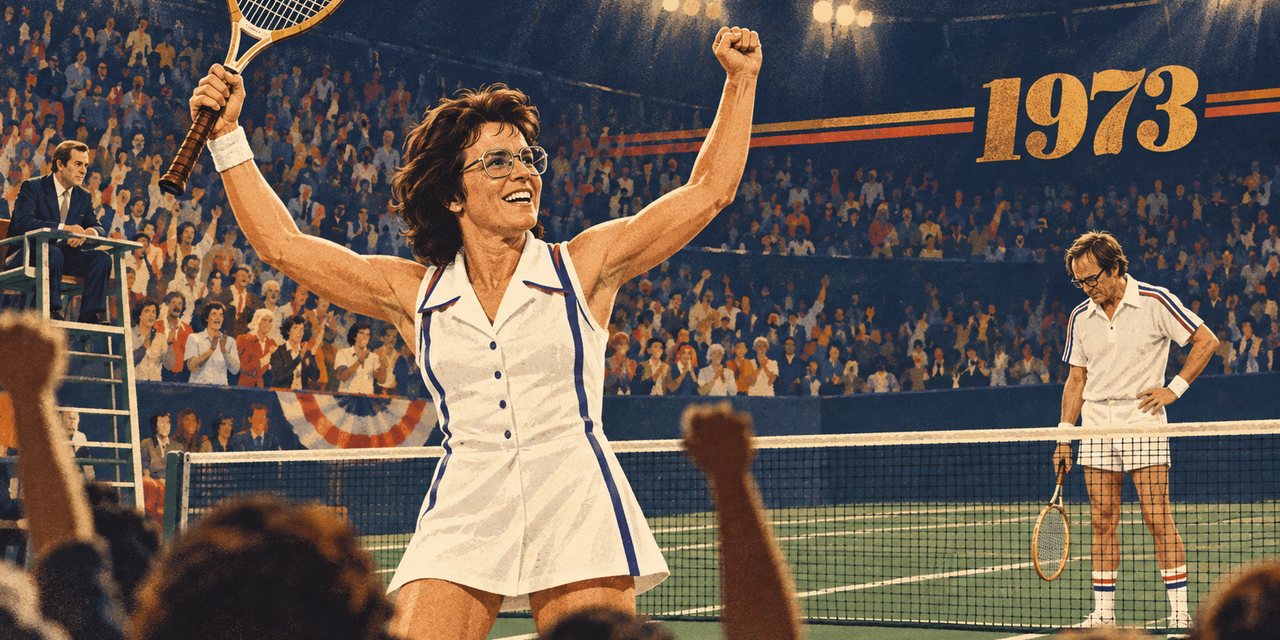
On September 20, 1973, Bobby Riggs entered the Houston Astrodome promising to prove that even a middle-aged man could defeat the finest woman in tennis.
Billie Jean King let him talk.
Then, before more than 30,000 spectators and an enormous worldwide television audience, she made him run. She moved him from side to side, dismantled his tricks, exposed his poor preparation, and defeated him in three straight sets. Riggs had built an international spectacle around the supposed inferiority of women. King ended it with a score no amount of male boasting could explain away.
It was 6–4, 6–3, 6–3.
A self-proclaimed male chauvinist had challenged one of the greatest athletes in the world. She accepted the pressure, controlled the court, and made him admit that he had underestimated her.
That is how Billie Jean King dominated history.
A Girl Who Refused to Accept Her Place
Billie Jean Moffitt was born in Long Beach, California, on November 22, 1943. She grew up in an athletic family and initially excelled at softball. Her parents encouraged her toward tennis, which was considered a more appropriate sport for a girl.
That attempted redirection did not make her smaller. It introduced her to the arena she would eventually transform.
King began playing on public courts and quickly recognized that tennis carried rules beyond those printed in its official books. The sport was overwhelmingly white, wealthy, and controlled by men. Even as a young player, she questioned why everyone wearing white seemed to be white as well.
She also saw how differently boys and girls were treated. Male players were regarded as serious competitors. Women were expected to remain attractive, agreeable, and grateful for whatever opportunities male officials allowed them.
King had no intention of being merely grateful.
At 17, she and Karen Hantze Susman won the women’s doubles championship at Wimbledon. King eventually accumulated 39 Grand Slam titles across singles, doubles, and mixed doubles, including 12 major singles championships. She became the world’s top-ranked woman and one of the most formidable competitors tennis had produced.
Her real dominance, however, reached beyond trophies.
Fighting the Men Who Controlled Women’s Tennis
When professional tennis began openly awarding prize money, women frequently received only a fraction of the men’s purse. At the 1968 Wimbledon Championships, King earned £750 for winning the women’s singles title. Men’s champion Rod Laver received £2,000.
The message was unmistakable. A woman could perform on the same famous courts, attract paying spectators, win the championship, and still be told that her achievement was worth less.
King did not politely wait for men to correct the inequality.
In 1970, she joined eight other women in signing symbolic one-dollar contracts with promoter Gladys Heldman. Known as the Original 9, they risked suspensions and damaged careers to establish an independent women’s professional circuit. Their rebellion helped create a viable women’s tour and laid the foundation for the Women’s Tennis Association, founded in 1973 with King as its first president.
That same year, the US Open became the first major tennis tournament to award equal prize money to its male and female champions.
King was already forcing the male establishment to surrender ground before Bobby Riggs came looking for attention.
The Man Who Made Sexism a Spectacle
Riggs had been an exceptional tennis player in his prime. He won Wimbledon singles, men’s doubles, and mixed doubles titles in 1939 and later became the world’s top-ranked male player. He was also a gambler, hustler, and relentless promoter who understood that outrage could be profitable.
By 1973, Riggs was 55 years old and eager to return to the spotlight. He publicly declared that women’s tennis was inferior and claimed that even at his age he could defeat the best female players.
The performance was deliberately excessive, but the beliefs he exploited were very real. Many men already considered female athletes weaker, less interesting, and undeserving of equal pay. Riggs simply gave those prejudices a loud voice and a mischievous grin.
King initially rejected his challenge. She understood that beating a retired man would prove little about the relative abilities of male and female professional athletes. Unfortunately, losing to him could be used to discredit every woman demanding equality.
Then Margaret Court accepted Riggs’s challenge.
Court was the leading women’s player at the time, but Riggs defeated her 6–2, 6–1 on May 13, 1973. The match became known as the Mother’s Day Massacre. Riggs celebrated shamelessly, the press amplified his taunts, and male chauvinists treated the result as confirmation that women did not belong beside men in elite athletics.
King knew she could no longer remain outside the spectacle. With the future of the women’s tour, public support for female athletes, and the cultural momentum surrounding Title IX all hanging over the event, she agreed to play him.
She later explained that she feared a loss could set women back 50 years. This was no harmless exhibition to her. She was walking onto the court carrying the credibility of an entire movement.
The Battle Begins
The match was held at the Houston Astrodome before a crowd of 30,472. Tens of millions more watched on television around the world.
Both players embraced the theater. King entered like Cleopatra, reclining on a decorated litter carried by shirtless men. Riggs arrived in a rickshaw pulled by women he called his “bosom buddies.” King presented him with a piglet, a playful answer to his self-appointed role as a “male chauvinist pig.”
It was colorful, ridiculous, and perfectly designed for television. Beneath the pageantry, however, King was intensely serious.
Riggs had expected her to play an aggressive serve-and-volley game. Instead, she remained patient and forced him into long exchanges. She sent balls deep, changed their pace, and made the older man cover the court. Rather than attempting to overpower him recklessly, she attacked his movement and endurance.
Riggs tried drop shots, lobs, spins, and the collection of irritating tricks that had frustrated other opponents. King refused to become impatient. She anticipated his shots, kept him working, and took control of the match.
The man who had spent months telling the world that women could not handle pressure was the one who began to wilt beneath it.
King won the first set 6–4. She took the second 6–3. By the third, Riggs’s grand claims had been reduced to survival. King finished him 6–3 and claimed the winner-take-all prize of $100,000.
There was no fourth set, no heroic male recovery, and no ambiguity in the result.
She had beaten him decisively.
He Underestimated Her
After the match, Riggs acknowledged the mistake at the heart of his defeat. He had underestimated Billie Jean King.
There is something wonderfully fitting about that admission. Riggs had not merely underestimated one opponent. His entire spectacle depended upon a culture that underestimated women routinely. Employers underestimated them. Athletic officials underestimated them. Broadcasters, sponsors, and spectators underestimated them. Men with institutional power treated women’s accomplishments as lesser before the competition even began.
King turned that habit of male arrogance against its spokesman.
Her victory did not prove that every woman could defeat every man at tennis. That was never the meaningful question. Riggs was a retired 55-year-old champion facing a 29-year-old champion in her prime. The match was an exhibition constructed for publicity.
Yet symbols matter, especially when prejudice is also being expressed symbolically. Riggs had made himself the representative of male superiority. King understood that defeating him in front of the world could puncture a belief that statistics, speeches, and private arguments had failed to dislodge.
She did not simply answer his words. She made him chase her answers across the court.
A Victory That Opened Doors
King’s influence did not begin or end with the Battle of the Sexes. By the time she faced Riggs, she had already helped establish a professional women’s tour, fought for equal prize money, and organized players through the Women’s Tennis Association.
Afterward, she continued using her fame to expand opportunities for others. She founded the Women’s Sports Foundation in 1974, promoted team tennis, coached professional athletes, and advocated for women and LGBTQ people. In 2006, the USTA National Tennis Center was renamed in her honor.
Her personal life also demanded courage. King was married to Larry King when she began understanding her attraction to women. In 1981, a former partner publicly outed her through a lawsuit. King lost endorsements almost immediately, but she refused to deny the truth about her sexuality. In time, she became a powerful advocate for LGBTQ equality as well as women’s rights.
The public saw the full cost of challenging the rules. King faced male-controlled institutions, unequal compensation, sexual scrutiny, and the threat of professional ruin. She continued competing anyway.
How Billie Jean King Dominated History
Billie Jean King dominated history because she recognized that excellence alone would not change an unjust system. A woman could win championships while the men governing her sport continued paying her less, limiting her opportunities, and dismissing her value.
She therefore did more than win. She organized.
She helped women build their own tour. She confronted the officials controlling their livelihoods. She demanded equal compensation. She accepted a match whose risks were far greater for her than for the man opposing her. Then, with millions watching and a professional provocateur waiting for her to fail, she played disciplined, intelligent tennis and defeated him in straight sets.
Bobby Riggs arrived at the Astrodome dressed as the master of ceremonies. Billie Jean King left as the master of the court.
For this submissive man, there is something especially satisfying about watching male arrogance receive such a public correction. Riggs talked, strutted, promoted himself, and invited the world to watch him put a woman in her place.
King showed him exactly where his place was.
It was on the other side of the net, exhausted, defeated, and finally admitting that he had underestimated her.












Hey ouchie. Great collection, but after watching all, my cock and balls began to hurt a lot. Probably in sympathy.…
As usual Mizz Geena, a very well written article on feminization. When I dress or wear makeup or walk in…
i have had to do this a few times in the past for a Woman. It started out with Her…
Goddess Barbara, I am very impressed with the quality and volume of your description of such a simple occurrence as…
Thank you, Mizz Geena for your poignant comments. There were a lot more good times than bad and remembering them…