























Anaïs Nin and the Art of Controlling Desire
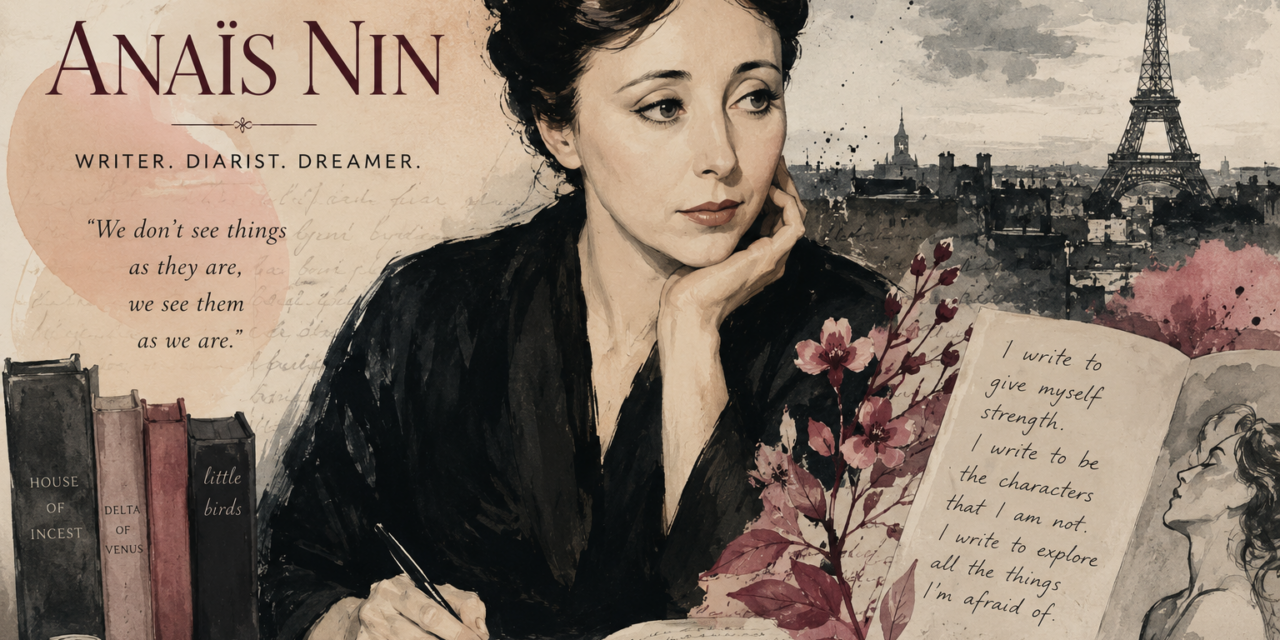
Some women dominate history through military victories, political revolutions, or scientific discoveries. Others transform the way entire generations think. Anaïs Nin belongs firmly in that second category. She did not command armies or rule nations, yet she changed how people understood desire, intimacy, sexuality, and personal freedom. At a time when women were often expected to remain silent about their inner lives, Nin spoke with remarkable honesty and confidence. Through her journals and fiction, she claimed authority over subjects that had long been defined by men, helping to reshape literature and culture in the process.
A Young Woman Determined to Understand Herself
Born in France in 1903 to Cuban and Danish parents, Anaïs Nin experienced a childhood marked by movement, uncertainty, and emotional upheaval. One of the defining events of her early life was her father’s departure from the family, a loss that would leave a lasting impression on her emotional world and later influence much of her writing.
As a young girl, Nin began keeping a diary. What started as a deeply personal practice evolved into a lifelong exploration of identity, relationships, creativity, and desire. Unlike many writers who sought to create distance between themselves and their work, Nin embraced self-examination. She believed that understanding the self was essential to understanding the world, and she approached that task with extraordinary dedication.
Over the course of her life, she filled thousands of pages with observations, reflections, dreams, and personal experiences. Those writings would eventually become some of the most celebrated journals in literary history.
The Diary That Changed Literary History
Anaïs Nin’s journals are among her greatest contributions to literature. They offered readers something rarely seen at the time: a woman speaking openly and thoughtfully about her own experiences without filtering them through social expectations or male perspectives.
For centuries, much of literature had been dominated by male voices. Women often appeared as subjects, muses, or supporting characters rather than as the authors of their own stories. Nin challenged that tradition. Her journals presented a woman who was thoughtful, intellectual, creative, ambitious, and unapologetically interested in understanding her own emotions and desires.
Readers were drawn to the honesty of her writing. Rather than presenting herself as perfect or uncomplicated, she revealed the contradictions and complexities that make people human. In doing so, she created a new model of personal writing that influenced generations of authors who followed.
Giving Women Ownership of Desire
Perhaps the most significant way Anaïs Nin dominated history was through her willingness to explore female desire openly. During much of the early twentieth century, discussions of sexuality were often shaped by restrictive social norms. Women were frequently portrayed as passive participants in romantic and sexual relationships, while men were viewed as the primary actors.
Nin rejected that framework.
In both her fiction and personal writings, women possessed desires, fantasies, curiosities, and ambitions of their own. They were not merely responding to the actions of others. They were making choices, pursuing experiences, and shaping their own lives.
This perspective may seem familiar today, but it was remarkably bold for its era. By presenting women as active participants in their own emotional and sexual experiences, Nin challenged longstanding assumptions and expanded the possibilities available to female characters in literature.
Her work helped create space for more honest conversations about intimacy and personal agency, conversations that continue to this day.
Exploring Power, Attraction, and Intimacy
What made Nin’s writing especially compelling was her understanding that desire extends far beyond physical attraction. She explored the emotional and psychological dimensions of relationships with unusual depth.
Her work frequently examined the ways people influence one another through affection, admiration, vulnerability, imagination, and emotional connection. She understood that relationships often involve subtle negotiations of power and that attraction can be shaped as much by the mind as by the body.
Rather than reducing intimacy to simple romance, Nin portrayed it as a complex and deeply personal experience. Her exploration of these themes gave readers a richer understanding of human relationships and helped establish her reputation as one of the most insightful writers of her generation.
Decades Ahead of the Sexual Revolution
Many of the ideas that made Anaïs Nin famous eventually became part of broader cultural conversations during the sexual revolution of the 1960s and 1970s. By that time, readers were beginning to challenge traditional assumptions about gender, sexuality, and personal freedom.
Nin had already spent decades exploring those subjects.
As her work reached larger audiences, many readers recognized that she had been addressing questions about autonomy, identity, and desire long before society was ready to confront them openly. Her willingness to examine these topics with honesty and sophistication made her a pioneering figure whose influence extended far beyond the literary world.
She was not merely following cultural change. In many respects, she helped prepare the ground for it.
Taking Control of the Narrative
One of the most important aspects of Anaïs Nin’s legacy is her insistence that women should control their own stories.
Throughout history, conversations about romance, attraction, sexuality, and relationships were often dominated by male voices. Men frequently determined how women were portrayed, what desires were considered acceptable, and which experiences deserved attention.
Nin challenged that tradition by placing women at the center of the narrative. Her female characters possessed agency, complexity, and authority. More importantly, her own voice carried those same qualities.
She did not wait for permission to write about difficult subjects. She simply wrote. Through that act, she demonstrated that women’s experiences were worthy of serious artistic and intellectual consideration.
That control over the narrative became one of her most enduring contributions. By telling her own story and encouraging others to do the same, she expanded the boundaries of what literature could accomplish.
Anaïs Nin’s Lasting Legacy
Today, Anaïs Nin remains one of the most influential literary voices of the twentieth century. Her journals continue to be studied, her fiction remains widely read, and her ideas still resonate with readers seeking a deeper understanding of identity, intimacy, and self-expression.
Modern discussions about female sexuality, emotional authenticity, and personal autonomy owe much to the path she helped create. Writers, scholars, and readers continue to engage with her work because the questions she explored remain relevant: Who controls our stories? Who defines desire? How do we understand ourselves honestly?
Anaïs Nin answered those questions by living and writing fearlessly.
That is how she dominated history. Not through political office, military power, or wealth, but through authorship. She seized control of the narrative surrounding desire and identity at a time when few women were allowed to do so. Through her words, she gave women greater authority over their own stories and changed the literary landscape forever.
Few writers leave behind a legacy that alters how people think about themselves. Anaïs Nin achieved exactly that, ensuring that women’s voices would no longer be confined to the margins, but would stand at the center of the conversation.

















Hi eleven. Appreciate the comments. I have had a number of cages over the years, but this is the first…
Hi eleven. Sounds like we have similar experiences with the metal vs. other types of cages. c.
Great article Duckie! Thank you for the how to instructions as well. I hope they don’t come in handy.
duckie, this gave me a smile. I do, however, think a short instructional video would have been useful. Perhaps we…
I have a few questions- 1. Does the submissive have the right to stop the event any point of time?…