

























Mary McLeod Bethune Built Power Through Education
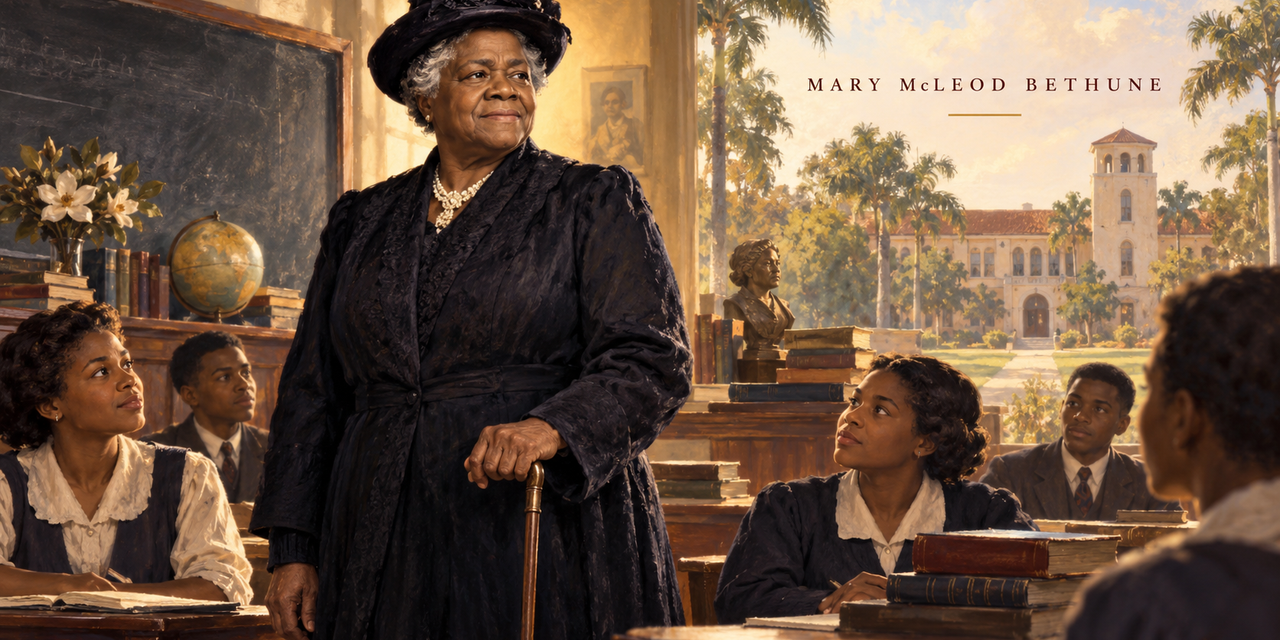
Mary McLeod Bethune began life as the daughter of formerly enslaved parents and became one of the most influential Black women in American history. She was an educator, institution builder, political strategist, presidential adviser, civil rights leader, and commanding advocate for women and children. She did not inherit wealth, social position, or political power. She created authority for herself and then used it to open doors for generations who followed.
Bethune understood that education was never merely about books and classrooms. In a society designed to keep Black Americans poor, politically powerless, and dependent upon white institutions, teaching a Black girl to read was a challenge to the established order. Helping that girl develop professional skills was even more threatening. Preparing her to become a leader was revolutionary.
Mary McLeod Bethune did all three.
The First Child in Her Family to Attend School
Mary Jane McLeod was born on July 10, 1875, near Mayesville, South Carolina. She was the fifteenth of seventeen children born to Samuel and Patsy McLeod, both of whom had been enslaved. Several of her older siblings had also been born into slavery before emancipation.
Her parents continued working after the Civil War and eventually acquired land of their own. Mary grew up helping her family in the cotton fields, but an opportunity to attend school changed the direction of her life. She became the first child in her family to receive a formal education, walking several miles each way to attend the one-room Trinity Mission School.
Whatever she learned during the day, she brought home and taught to her parents and siblings. Even as a child, Bethune was already transforming her personal education into a resource for others. Knowledge was not something she intended to possess quietly. It was something to be shared, organized, and turned into power.
Her teacher, Emma Jane Wilson, helped her obtain a scholarship to Scotia Seminary in North Carolina. Bethune later continued her studies at the Moody Bible Institute in Chicago. She hoped to become a missionary in Africa, but missionary authorities rejected her application. The precise reasons have been described differently in accounts of her life, but Bethune believed racial prejudice prevented her from receiving the opportunity.
The rejection could have ended her ambitions. Instead, it redirected them. If she would not be permitted to serve as a missionary abroad, she would pursue her mission at home.
A School Built With Almost Nothing
Bethune taught in several schools before moving to Daytona, Florida, in 1904. There, with approximately $1.50, she opened the Daytona Educational and Industrial Training School for Negro Girls. Its first class consisted of five girls and her young son.
She made desks and benches from discarded crates. Students produced ink from elderberry juice and made pencils from charred wood. Bethune sold sweet potato pies and ice cream to raise money, solicited donations, and persuaded community members to provide whatever labor or materials they could spare.
The school grew because Bethune refused to allow its poverty to define its potential. She cultivated support from Black churches and families while also approaching wealthy white benefactors. This required discipline, diplomacy, and an extraordinary ability to command attention in rooms where a Black woman was rarely treated as an equal.
Bethune learned how to present potential supporters with a vision so compelling that they wanted to become part of it. She could be gracious without becoming submissive, politically careful without surrendering her purpose, and respectful without forgetting her own authority.
Her school eventually merged with the Cookman Institute for Men, forming the institution that became Bethune-Cookman College and later Bethune-Cookman University. Bethune served as its president, making her one of the few women in the country to lead a college during that era.
The woman who began with crates, homemade pies, and five girls had built an institution capable of educating thousands.
She Expected More From Her Students
Bethune did not believe education should teach Black students to accept the narrow roles white society permitted them. She wanted her students prepared to earn a living, but she also wanted them to develop discipline, confidence, cultural pride, and a responsibility to serve their communities.
She maintained demanding standards. Students were expected to keep themselves and their surroundings orderly, perform their duties properly, and recognize that their conduct represented something larger than themselves. Bethune could be warm and maternal, but she was also formidable. Her students commonly called her “Mother Bethune,” a title that reflected affection without diminishing her command.
She understood the particular importance of educating girls. When women gained knowledge, professional skills, and financial independence, the effects spread through families and communities. An educated woman could teach children, organize neighbors, earn money, challenge mistreatment, and demand a place in public life.
Bethune was not simply preparing girls to survive. She was preparing them to exercise influence.
Defying Terror and Defending the Vote
Building a successful school for Black students in the Jim Crow South was dangerous. Bethune’s work challenged racial and gender hierarchies simultaneously, and the Ku Klux Klan reportedly threatened her school.
According to accounts preserved by the National Park Service and other historians, Klansmen once marched near the campus in an attempt to intimidate her. Bethune and others kept watch, determined to protect the school. She did not allow the threat to halt its work.
Her defiance continued at the ballot box. After the ratification of the Nineteenth Amendment, Bethune worked to register Black women to vote. Legal voting rights did not prevent Southern officials and white supremacists from using poll taxes, literacy tests, threats, and violence to keep Black citizens away from the polls.
Bethune helped organize registration efforts and used her school to prepare prospective voters for discriminatory literacy tests. The intimidation became so severe that armed men reportedly appeared near the school. Still, Bethune and the women she organized went to vote.
Men had created the rules, controlled the polling places, and constructed barriers intended to frighten Black women back into political silence. Bethune helped those women walk straight through the resistance.
Building a National Organization for Black Women
Bethune recognized that individual achievement was not enough. Black women needed an organized national voice capable of turning their local work into political influence.
In 1935, she founded the National Council of Negro Women. Rather than replacing existing women’s organizations, the council brought groups together so they could coordinate their efforts and speak with greater authority. It addressed education, employment, health, housing, voting rights, and discrimination.
Bethune built coalitions among women who did not always agree on methods or priorities. She understood that leadership involved more than giving inspiring speeches. It required managing personalities, securing money, cultivating alliances, and keeping organizations focused on achievable goals.
She was particularly skilled at dealing with powerful men. Bethune could flatter when useful, confront when necessary, and refuse to be dismissed. She entered political spaces created almost entirely by white men and made herself too knowledgeable, too connected, and too effective to ignore.
A Black Woman Inside the Roosevelt Administration
Bethune’s friendship with First Lady Eleanor Roosevelt helped bring her into the center of national politics, but she was no ceremonial guest. Her administrative ability and political network made her a valuable adviser during Franklin D. Roosevelt’s presidency.
She became director of the Division of Negro Affairs within the National Youth Administration, the federal agency responsible for providing education, training, and employment opportunities to young Americans during the Great Depression. In that role, Bethune became the highest-ranking Black woman in the federal government at the time.
She fought to ensure that Black young people received a fairer share of federal programs. Under her leadership, the division expanded access to training and employment while directing attention toward the specific barriers facing Black students and workers.
Bethune also helped organize the informal group of Black federal officials and advisers that became known as the Black Cabinet. These leaders pressed the Roosevelt administration to consider Black Americans when developing New Deal programs and federal policies.
There is something deeply satisfying about imagining Bethune in Washington, her cane in hand, moving among politicians accustomed to controlling every conversation. She knew the men around her possessed official authority, but she also knew that authority was useless without information, organization, and public support. Bethune brought all three.
She did not always obtain everything she demanded. Roosevelt’s administration failed to confront segregation and racial violence as forcefully as Bethune and other civil rights leaders wanted. Yet her presence established a model of Black female political leadership at the highest levels of government.
Her Cane Became a Symbol of Command
Bethune became known for carrying a cane, although she did not initially require one for mobility. It was part of her carefully cultivated public image. She reportedly said it gave her “swank.”
The cane suited her. It made her instantly recognizable and reinforced the dignity with which she entered public spaces. Bethune understood that presentation could be a form of power. In a society eager to diminish her, she appeared impeccably dressed, composed, and entirely conscious of her importance.
She cultivated relationships with presidents, philanthropists, educators, and international leaders, but she never allowed proximity to powerful people to become a substitute for accomplishing something. Access was valuable because she could use it. Every introduction, meeting, and appointment became another opportunity to obtain resources or recognition for Black Americans.
Bethune was sometimes described as regal. The word was appropriate, but her authority did not come from aristocratic distance. It came from work, competence, preparation, and the knowledge that she represented people whose needs were routinely ignored.
From the Classroom to the World Stage
Bethune’s influence extended beyond education and domestic politics. During World War II, she worked to expand opportunities for Black women in the military and advocated for the integration of the Women’s Army Corps. She also assisted with efforts involving Black officer candidates and supported the inclusion of Black pilots in aviation training programs.
In 1945, Bethune attended the United Nations Conference on International Organization in San Francisco as a consultant representing the National Association for the Advancement of Colored People. She was among the few Black women participating in the historic gathering that produced the United Nations Charter.
By then, the daughter of formerly enslaved agricultural workers had become an internationally recognized leader. She had not simply entered history. She had forced history to make room for her.
The Authority She Left Behind
Mary McLeod Bethune died on May 18, 1955, but she carefully articulated what she wanted to leave to future generations. In her final testament, she described a legacy that included love, hope, confidence, education, racial dignity, and responsibility to young people.
Her legacy also exists in brick, policy, and institutional memory. Bethune-Cookman University continues the educational mission she began in a rented building. The National Council of Negro Women remains part of the movement she organized. Historic sites preserve the places from which she directed campaigns for education and civil rights.
In 2022, a statue of Bethune was installed in the United States Capitol’s National Statuary Hall Collection as Florida’s representative. She became the first Black person selected by a state to be represented in the collection. Her statue replaced one honoring Confederate general Edmund Kirby Smith.
The symbolism could hardly be more powerful. A woman born to formerly enslaved parents now stands in the Capitol where lawmakers once defended segregation and denied people like her a meaningful political voice.
Mary McLeod Bethune dominated history because she recognized education as a foundation for independence and organized power. She built a school when she lacked money, mobilized voters in the face of racial terror, united Black women into a national force, and advised presidents who could no longer afford to overlook her.
She did not wait for powerful men to offer her a place. She built institutions, gathered supporters, developed expertise, and arrived with an authority they were compelled to recognize. As a submissive man writing about her life, I cannot help but admire the certainty with which she exercised that authority. Mary McLeod Bethune knew what her people deserved, knew she was capable of advancing their cause, and expected others to step aside or help her accomplish it.
That is how an educator became a national commander and how Mary McLeod Bethune dominated history.


















The little “Good Elf” notes are a sweet idea—personal praise feels way more meaningful than generic holiday gifts. I’d tuck…
Ty Eleven !! I can be quite the little collector!
You are just very persuasive, Mizz Geena!!
I think you mean - three so far! Great journey and pink really is a great colour Mayi.
Wow! i wouldn't have seen that coming and man the restraint you had for that. I guess that is one…