























Tarana Burke Dominated History by Changing the Conversation
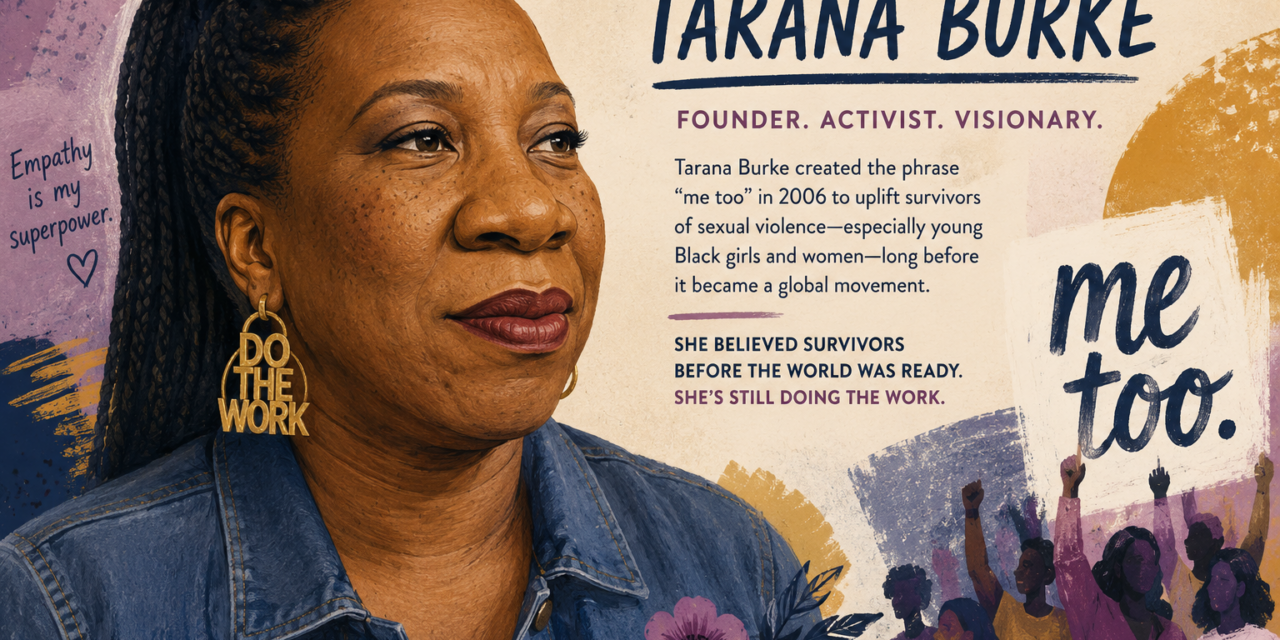
History often remembers social movements by the moment they explode into public consciousness. A celebrity speaks out, a hashtag goes viral, and suddenly the world pays attention. What history sometimes overlooks are the people who spent years laying the foundation before anyone was watching. Tarana Burke is one of those people. Long before millions shared the words “Me Too” online, Burke was quietly creating a movement built on compassion, healing, and the belief that survivors deserved to be heard. As I researched her life, I found myself admiring not only the scale of her impact but the patience behind it. She never sought fame. She sought justice, and she understood that meaningful change begins one person at a time.
Growing Up with a Sense of Justice
Tarana Burke was born on September 12, 1973, in the Bronx, New York. She grew up in a family where community involvement and social justice were everyday conversations rather than abstract ideals. Her mother encouraged civic engagement, exposing Burke to activism from an early age and teaching her that ordinary people had the power to improve their communities. Those lessons stayed with her throughout her life and shaped the path she would eventually follow.
As a teenager, Burke became involved in youth leadership programs and grassroots activism. Working closely with underserved communities, she witnessed firsthand how inequality affected every aspect of people’s lives. She also saw something else that deeply troubled her. Survivors of sexual violence, especially young Black girls, were often ignored, blamed, or left without meaningful support. The more she listened, the more she realized that countless people carried enormous trauma in silence because they feared they would not be believed.
The Birth of Me Too
The phrase “Me Too” did not begin as a social media campaign. Burke founded the Me Too movement in 2006 after years of working directly with survivors of sexual violence. The inspiration came from an earlier encounter with a young girl who disclosed that she had experienced sexual abuse. Burke later admitted that she felt unprepared in that moment and walked away wishing she had simply told the girl, “Me too.” Those two words became the emotional foundation of everything that followed because they communicated solidarity instead of sympathy. They told survivors that they were not isolated, broken, or alone.
From its earliest days, Burke envisioned Me Too as a movement focused on healing rather than headlines. She was not trying to create a campaign that would expose famous perpetrators or generate media attention. Instead, she wanted survivors to find one another, build supportive communities, and begin the difficult process of reclaiming their lives. That survivor-centered philosophy distinguished her work from many advocacy efforts that focused primarily on punishment instead of recovery.
More Than a Decade of Quiet Work
For more than ten years after founding Me Too, Burke continued her work with little national recognition. She organized workshops, developed leadership programs, mentored survivors, and created spaces where people could share experiences without fear of judgment. Much of this work happened in local communities rather than national stages. There were no television appearances or international conferences waiting for her. Instead, there were conversations, support groups, classrooms, and community organizations where lasting relationships were formed.
Looking back, it becomes clear that these years were the true foundation of the movement. Burke was not building a slogan. She was building trust. She believed survivors needed more than public sympathy after tragedy. They needed practical support, long-term healing, and opportunities to become leaders themselves. That patient, grassroots approach gave Me Too a depth that allowed it to endure long after media attention shifted elsewhere.
When the World Finally Took Notice
In October 2017, allegations against Hollywood producer Harvey Weinstein prompted actress Alyssa Milano to encourage people on social media to post “#MeToo” if they had experienced sexual harassment or assault. Within days, millions of people around the world had shared their stories. The hashtag spread across countries, languages, and cultures with astonishing speed, becoming one of the largest social movements in modern history.
As journalists investigated the origins of the phrase, they discovered Tarana Burke and the work she had begun more than a decade earlier. Suddenly, she found herself thrust onto the international stage. While many people viewed Me Too as something entirely new, Burke knew it was simply the moment the world had finally caught up with work that had been happening for years. Rather than allowing the movement to become defined solely by celebrity scandals, she consistently redirected attention toward survivors whose stories had always been ignored. She reminded audiences that Me Too was never intended to be just a hashtag. It was meant to create healing, accountability, education, and lasting cultural change.
Centering Survivors Instead of Celebrity
One of Burke’s greatest strengths has been her refusal to let media attention distract from the movement’s original purpose. While headlines often focused on famous actors, politicians, or executives accused of misconduct, Burke continually emphasized that sexual violence affects people in every community and every walk of life. Many survivors would never appear on television or make international news, but their experiences mattered just as much. They deserved dignity, support, and the opportunity to heal regardless of whether anyone else knew their names.
She also broadened conversations beyond individual perpetrators, encouraging society to examine the systems that allow abuse to flourish. Issues such as racism, economic inequality, workplace power imbalances, and institutional failures became central parts of the discussion. Burke argued that meaningful progress required addressing these underlying structures rather than simply reacting to one scandal after another. That broader perspective helped transform Me Too from a moment into an ongoing movement.
Global Influence
The influence of Burke’s work quickly spread around the world. Survivors across dozens of countries adopted the language of Me Too while adapting it to their own cultures and legal systems. Schools revised policies, corporations strengthened reporting procedures, governments examined workplace protections, and organizations across countless industries began confronting issues that had previously been ignored or minimized. Progress has not been uniform, and many challenges remain, but the conversation itself has fundamentally changed.
Perhaps Burke’s greatest contribution is that she gave millions of people language for experiences they had struggled to describe. Before Me Too, many survivors believed they were alone or somehow responsible for what had happened to them. By encouraging people to simply say “me too,” Burke created an immediate sense of solidarity that crossed barriers of age, race, nationality, profession, and social status. Few phrases in modern history have carried so much emotional power with so few words.
Continuing the Mission
Following the movement’s global recognition, Burke became an internationally respected speaker, educator, and author. Her memoir, Unbound: My Story of Liberation and the Birth of the Me Too Movement, offers an honest account of both her personal journey and the evolution of her advocacy. Throughout interviews, speeches, and public appearances, she has remained remarkably consistent in her message. Healing must remain at the center of justice, survivors must continue leading the conversation, and lasting cultural change requires far more than viral moments.
Even after receiving worldwide recognition, Burke has continued to focus on community-building, restorative practices, and supporting those whose voices are still too often overlooked. Fame may have expanded her platform, but it never changed her mission.
Tarana Burke’s Legacy
Tarana Burke dominated history without seeking power, wealth, or public acclaim. She changed the world by changing the way people speak to one another after unimaginable trauma. She recognized that survivors needed more than legal reforms or public outrage. They needed compassion, belief, and communities where healing could begin. That simple but profound insight reshaped one of the most important conversations of the modern era.
As I reflect on Burke’s legacy, what stands out most is that she never waited for society to be ready. She began the work anyway. She spent years listening when few others would, believing survivors when many doubted them, and building a movement before the world understood why it was necessary. When millions finally embraced the words “Me Too,” they were stepping onto a foundation Tarana Burke had already spent years constructing. That quiet determination, more than any viral hashtag, is why her influence will continue to shape history for generations to come.

















Thank you for sharing this, Levi. Tarana Burke’s patience, compassion, and unwavering commitment to supporting survivors are truly inspiring. She showed that real strength comes from listening, standing up for others, and creating lasting change. A remarkable woman whose impact will continue for generations.