
























Clara Lemlich and the Strike That Changed American Labor
There are moments in history when authority does not belong to the person holding the highest office, controlling the most money, or occupying the center of the stage. It belongs to the person with the courage to stand up and issue the command everyone else has been afraid to give.
For Clara Lemlich, that moment arrived on November 22, 1909. She was a 23-year-old Jewish immigrant and garment worker surrounded by prominent male labor leaders who had spent hours delivering speeches about solidarity. Lemlich had already endured miserable factory conditions, arrests, intimidation, and a beating that left her with broken ribs. She had not come to hear more men talk cautiously about what workers might someday do.
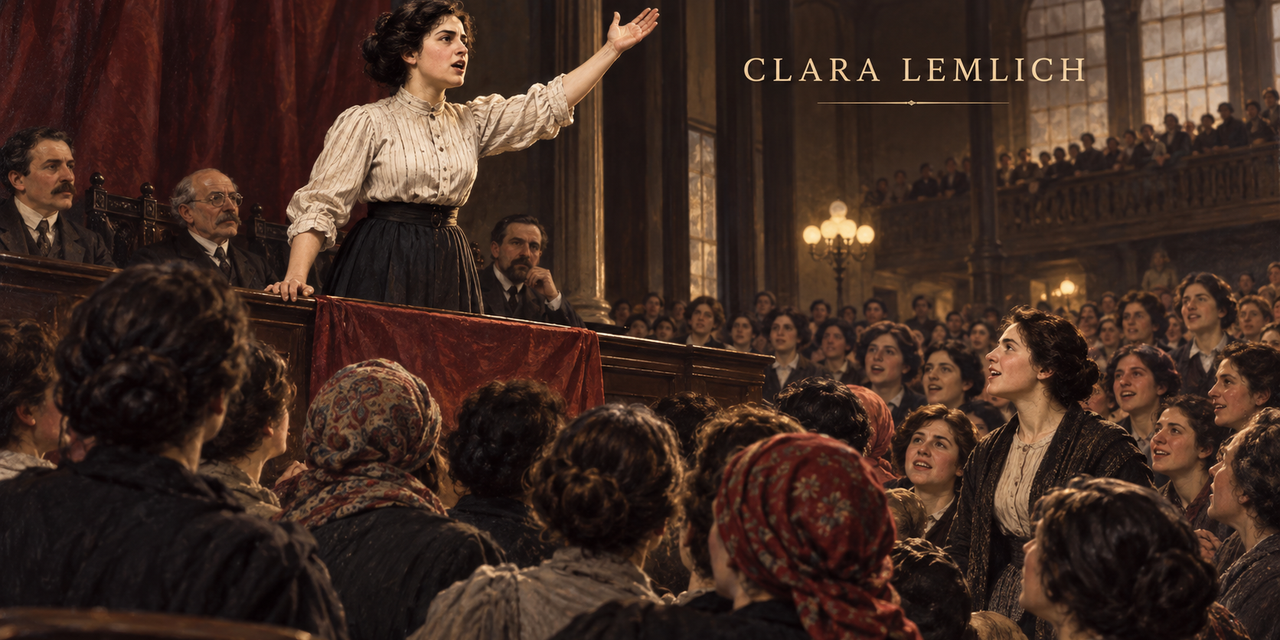
She rose from the audience, demanded the right to speak, and called for a general strike. Thousands answered her.
That single act helped launch the Uprising of the 20,000, one of the most important labor actions led by women in American history. Yet Lemlich’s commanding intervention was not an isolated moment. It was the clearest expression of a character she carried throughout her life. Whenever an institution failed working women, immigrants, tenants, mothers, or the elderly, Clara Lemlich organized people to challenge it.
A Girl Who Refused to Remain Uneducated
Clara Lemlich was born on March 28, 1886, in Gorodok, a town in what was then the Russian Empire and is now Ukraine. She grew up in a Jewish family during a period of antisemitic persecution, political upheaval, and strictly defined expectations for girls. Her parents permitted her to learn Yiddish, but Clara wanted access to the broader world of Russian books and revolutionary ideas.
She taught herself to read Russian despite her parents’ objections. To afford books, she sewed buttonholes and wrote letters for neighbors who could not write for themselves. Even as a girl, she was unwilling to accept that knowledge belonged to someone else or that tradition could determine the boundaries of her mind.
Her exposure to revolutionary literature introduced her to arguments about socialism, workers’ rights, and political resistance. These ideas did not create her rebellious nature so much as give it a vocabulary. Lemlich already understood that obedience was frequently demanded by people who benefited from keeping others powerless.
Following a wave of anti-Jewish violence, the Lemlich family immigrated to the United States in 1903. Like many immigrants arriving in New York, Clara found that America offered opportunity wrapped in exploitation. She soon entered the city’s garment industry, where young immigrant women were expected to work exhausting hours for pitiful wages under humiliating and often dangerous conditions.
Inside the Garment Factories
The women who made fashionable shirtwaists for wealthier customers worked in crowded factories with inadequate ventilation, poor sanitation, and few meaningful safety protections. They could be fined for mistakes, lateness, damaged materials, or behavior supervisors considered improper. Many worked six or seven days a week and were subjected to relentless pressure from male foremen and factory owners.
Lemlich refused to lower her eyes and endure it quietly. She joined the International Ladies’ Garment Workers’ Union and became an organizer for Local 25. The union movement itself was heavily influenced by men, many of whom doubted that young women could be organized effectively. Some believed female workers were too timid, too temporary, or too concerned with marriage and family to sustain a serious labor campaign.
Clara proved them wrong.
She helped organize strikes among shirtwaist workers and became known for moving between factories, speaking to women about their conditions, and persuading them to act collectively. She also challenged union leaders who treated women workers as secondary to skilled male tradesmen. Lemlich understood something those men had missed: the young women were not naturally passive. They had simply been denied leaders willing to recognize their anger.
Employers responded with violence. Hired thugs attacked picketers while police frequently arrested the strikers rather than the men assaulting them. During one confrontation, Lemlich was beaten so badly that several of her ribs were broken. The attack might have intimidated a less determined organizer. Clara returned to the picket line.
The Night She Took Command
By November 1909, garment workers at the Triangle Shirtwaist Company and the Leiserson Company were already striking. On November 22, thousands gathered at Cooper Union to discuss the crisis. Well-known male socialists and labor officials addressed the crowd for approximately two hours. Their speeches expressed support, but stopped short of calling all shirtwaist workers out on strike.
Lemlich had lost patience.
Still recovering from her injuries, she made her way toward the stage and demanded an opportunity to speak. Once given the floor, she addressed the audience in Yiddish. She declared that she was tired of listening to speakers and moved that the workers begin a general strike.
The effect was electrifying. The crowd rose in support and participants pledged themselves to the cause. Within the following days, approximately 20,000 garment workers, most of them young immigrant women, walked away from their machines.
It is difficult to imagine a more fitting example of a woman dominating history. Clara Lemlich entered a meeting controlled by established men, rejected their caution, and replaced discussion with her own command. The men on the platform had reputations and titles. Lemlich had broken ribs, factory experience, and the confidence of the women who actually had to risk their jobs. When she spoke, it was her authority that mattered.
The Uprising of the 20,000
The strike continued through the bitter New York winter. Young women stood on picket lines while facing cold, hunger, arrests, insults, and physical attacks. Wealthier supporters from the Women’s Trade Union League joined some of the demonstrations, providing publicity and a degree of protection, but the courage of the garment workers remained the force driving the uprising.
Lemlich became one of its most energetic leaders. She spoke at rallies, encouraged hesitant workers, and continued until she reportedly lost her voice. The strike exposed conditions inside the garment industry and forced the public to confront the treatment of women whose labor produced the city’s clothing.
By the time the strike ended in February 1910, many employers had agreed to improved wages, reduced hours, and recognition of union representation. The settlement was incomplete, however. Some of the largest manufacturers, including the Triangle Shirtwaist Company, refused to accept crucial demands involving workplace safety and union recognition.
That failure took on horrifying significance on March 25, 1911, when a fire swept through the Triangle factory. Locked exits and inadequate safety measures contributed to the deaths of 146 workers, most of them young immigrant women and girls. The tragedy confirmed what Lemlich and other organizers had been saying all along. Dangerous working conditions were not merely unfair. They were deadly.
Challenging Political Power
Lemlich’s prominence came at a personal cost. Employers blacklisted her, making it difficult for her to find work in the garment trade. She also clashed with conservative elements within the labor movement. Yet removing her from the factory did not remove her from the struggle.
She turned her attention toward women’s suffrage. For Lemlich, voting rights were not an abstract symbol of equality. They were a practical weapon working women needed to defend themselves. Factory owners, supervisors, inspectors, and male legislators possessed political influence. The women laboring under their authority did not.
Lemlich argued that officials had little reason to listen when a disenfranchised working woman demanded clean factories, shorter hours, or safer conditions. She helped establish the Wage Earners’ Suffrage League, which centered the concerns of working-class women rather than allowing the movement to be controlled entirely by wealthier reformers.
Once again, she challenged authority within a movement that was supposedly fighting for her rights. She would work with privileged allies when useful, but she refused to pretend that all women experienced oppression in the same way. A wealthy suffragist and an immigrant factory worker might both lack the vote, but only one returned home after a punishing shift in a sweatshop.
Organizing Women Beyond the Factory
Lemlich married printer and fellow activist Joe Shavelson in 1913, and they had three children. Marriage and motherhood changed the setting of her political work, but they did not domesticate her defiance. Instead, she recognized the home and neighborhood as additional battlegrounds.
She organized working-class housewives around food prices, rent, education, and support for striking workers. Lemlich understood that exploitation did not end when a woman left a factory. Landlords could raise rents, merchants could inflate food prices, and families could be evicted when wages disappeared.
She became involved in organizations of working-class women and helped build a network that eventually extended beyond New York. During a major 1935 campaign against high meat prices, women organized boycotts and picketed butcher shops. Thousands of shops were affected as consumers demonstrated that women responsible for household purchasing possessed considerable economic power when they acted together.
This was another area where Lemlich dominated assumptions, including those held by men within left-wing political organizations. Some male activists dismissed household concerns as less important than factory struggles. Lemlich recognized that a woman controlling a family’s purchases could become a powerful political force. The housewife was not outside the labor movement. She was managing the place where low wages, high prices, and inadequate housing produced their most intimate consequences.
A Lifetime of Defiance
Lemlich’s politics remained firmly on the radical left. She joined the Communist Party and continued supporting causes involving workers, tenants, civil rights, peace, and opposition to fascism. Her political affiliations made her controversial, particularly during the intense anticommunism of the Cold War. Her passport was revoked after she visited the Soviet Union in 1951.
A respectful biography should neither conceal her communism nor reduce her entire life to it. Lemlich’s political commitments were part of who she was, including positions that remain open to criticism. Yet her central loyalty was remarkably consistent. She stood with people whose labor, homes, safety, or dignity were controlled by more powerful institutions.
Even old age could not make her obedient. After moving to California and entering a Jewish home for the aged in her eighties, Lemlich supported the United Farm Workers’ grape and lettuce boycotts. She also encouraged workers at the facility to organize.
The woman who had once rallied garment workers was now organizing from inside a nursing home. She apparently saw no reason that age should require silence, and no institution was too small or too comfortable to escape her scrutiny.
Clara Lemlich died in 1982 at the age of 96. She had spent more than seven decades refusing to behave as powerful people expected.
The Woman Who Ended the Talking
Clara Lemlich’s historical legacy reaches far beyond the famous speech at Cooper Union. She organized factory workers, confronted male union leaders, fought for women’s suffrage, mobilized consumers, resisted evictions, supported civil rights, and remained politically active into her final years.
Still, that night in 1909 captures her particular form of authority. A succession of important men had spoken while thousands waited. Then a young immigrant woman rose and decided that the time for speeches was over.
She did not ask the workers to admire her bravery. She demanded that they discover their own. She did not wait for established leaders to grant permission. She issued the motion herself and watched an enormous crowd accept it.
On Labor Day, we remember that the rights enjoyed by workers were not gifts benevolently handed down by employers or politicians. They were won by people willing to disrupt business, defy authority, and endure retaliation. Clara Lemlich dominated history because she possessed the rare ability to recognize the precise moment when anger had to become action.
The powerful men in that hall had the stage. Clara Lemlich had the workers. History followed her.






















Levi, I really enjoyed this article about Clara Lemlich. What stood out to me most was that she did not just sit back and wait for someone else to take charge. She saw something that was wrong, understood what needed to be done, and had the courage to act even when powerful people around her disagreed.
As a submissive, I think there is something important for me to learn from that. Serving does not mean being passive or waiting for every little instruction. I should pay attention, understand what is expected of me, take responsibility for my actions, and have the courage to step up when my service requires it. I want to learn to be more useful and dependable rather than simply waiting for commands. Thank you for sharing her story, Levi.