























How Much Ejaculation Can a Healthy Man Handle?

How Many Orgasms Are Too Many?
Nutt Up November has arrived, and across the FemdomU community, submissive men are discovering that their usual masturbation habits may not be enough to satisfy their Dominant partners’ expectations. Some are being challenged to orgasm every day, others are attempting multiple orgasms in a single day, and a particularly ambitious few are trying to see just how much their bodies can handle. As a retired nurse, I find this fascinating, but it also raises an important medical question: How many orgasms are too many? An orgasm is the pleasurable neurological and muscular response associated with sexual climax, while ejaculation is the physical release of semen. They usually occur together in men, but they are separate physiological processes. Understanding that distinction, along with how the body recovers from repeated sexual activity, is essential for anyone participating in an intensive orgasm challenge.
Let me begin with something that may surprise a few of our more enthusiastic Dominants. There is no medically established maximum number of orgasms a healthy adult man can safely experience in one day, one week, or one month. There is also no universal minimum number required for good sexual health. A man who ejaculates once a week may be perfectly healthy, while another who ejaculates three times a day may also be perfectly healthy. The difference depends on individual physiology, age, overall health, medications, physical comfort, and how well the body tolerates repeated stimulation.
That does not mean unlimited orgasms are automatically harmless. It means we need to look at what is happening to the individual man rather than assuming that a particular number is safe for everyone.
What Actually Happens During Repeated Orgasms?
When a man becomes sexually aroused, his nervous system, blood vessels, muscles, and reproductive organs participate in a coordinated physiological response. During ejaculation, rhythmic muscular contractions help move semen through the reproductive tract and out of the penis. Afterward, the body begins returning toward its resting state.
For many men, this recovery includes a refractory period, a temporary interval during which another orgasm or erection is difficult or impossible. The length of that period varies considerably.
A younger man might recover relatively quickly, while an older man may need considerably longer. Some men can experience another orgasm shortly after the first, while others require hours or more before they feel physically ready.
Age is relevant, but it is not the only factor. Sleep, stress, cardiovascular health, medications, hormone levels, and individual differences all influence sexual response.
During Nutt Up November, a submissive who normally masturbates every other day might suddenly be expected to complete two or three sessions daily. He may discover that the first orgasm comes easily, the second requires more time, and the third is difficult or simply not possible.
That progression is not necessarily evidence of a medical problem. It may simply reflect his normal refractory period, temporary fatigue, or a reduction in arousal following repeated stimulation.
However, difficulty reaching another orgasm should never be interpreted as a reason to increase physical force or continue stimulation through pain.
Is Three Orgasms a Day Too Many?
I know several of our FemdomU participants are experimenting with multiple daily orgasms, so let’s address this directly.
For some healthy adult men, three orgasms in a day may be entirely tolerable. Others may find that even two consecutive sessions leave them uncomfortable, exhausted, or temporarily uninterested in further stimulation.
There is no clinical evidence establishing three orgasms per day as inherently dangerous. Equally, there is no convincing evidence that three daily orgasms provide substantially greater health benefits than one.
What different frequencies might mean
| Frequency | Medical perspective |
|---|---|
| Once daily | Generally well tolerated by many healthy adults |
| Twice daily | May be comfortable, depending on recovery and technique |
| Three times daily | Possible for some, but irritation and fatigue may become more likely |
| Four or more daily | Requires greater attention to recovery and physical symptoms |
| Several days without orgasm | Also medically normal for most adults |
These are observations, not prescribed limits or medically validated safety thresholds. A man experiencing pain after his second orgasm should stop, even if another man comfortably completes four.
One important consideration is the cumulative effect of repeated friction. A single session may produce no discomfort, but multiple sessions throughout the day can gradually irritate the skin and surrounding tissues.
In other words, the problem is not always the orgasm itself. Sometimes it is everything the man does to reach it.
The Difference Between Healthy Sensitivity and Irritation
One of the most common complaints associated with frequent masturbation is increased penile sensitivity. Unfortunately, people sometimes use the word sensitivity to describe two very different experiences.
Normal post-orgasm sensitivity can make the glans or surrounding tissue temporarily uncomfortable to touch. This is generally short-lived and resolves as the body recovers.
Irritation, on the other hand, may involve redness, burning, tenderness, swelling, chafing, or small abrasions. These symptoms suggest that the skin or underlying tissues have been subjected to more friction or pressure than they can comfortably tolerate.
A submissive who reports that his penis feels unusually sensitive immediately after orgasm may simply need recovery time. A submissive who reports burning, visible redness, or discomfort when clothing touches his penis may be developing friction-related irritation.
These conditions should not be treated as interchangeable.
Why lubrication matters
Adequate lubrication can reduce friction and lower the likelihood of skin irritation during masturbation. However, lubrication does not eliminate the possibility of injury, especially when stimulation is prolonged or repeated frequently.
Choose a lubricant compatible with the skin and any toys being used. Fragranced products and substances that cause stinging or burning should be avoided.
Repeatedly applying lubricant to already irritated skin does not necessarily make continued masturbation safe. Sometimes the appropriate treatment is simply to stop and allow the tissues to recover.
Does Frequent Ejaculation Deplete the Body?
There is a persistent myth that frequent ejaculation drains a man of essential nutrients, weakens his immune system, or permanently reduces his physical strength.
The medical evidence does not support those claims.
Semen contains water, proteins, sugars, minerals, and other substances, but the quantities lost during ejaculation are generally small. A healthy adult does not ordinarily need special supplements, replacement meals, or extraordinary hydration simply because he ejaculates frequently.
Repeated ejaculation may produce a temporary reduction in semen volume, particularly when little time has passed between sessions. This is a normal physiological response and does not mean the reproductive system has been damaged or permanently depleted.
Similarly, a man who experiences temporary fatigue after sexual activity is not necessarily suffering from nutritional deficiency. Physical exertion, relaxation, sleep deprivation, and the body’s normal response to orgasm may all contribute.
For our Nutt Up November participants, my advice is straightforward. Maintain normal hydration, eat balanced meals, get sufficient sleep, and avoid treating masturbation as an endurance competition that must continue regardless of how you feel.
You do not need a special recovery drink after every orgasm. You do need enough common sense to recognize when your body wants a break.
What About Prostate Health?
This is where the medical discussion becomes particularly interesting.
Researchers have investigated whether ejaculation frequency is associated with prostate cancer risk. One frequently cited study, published in European Urology in 2016, followed tens of thousands of men from the Health Professionals Follow-up Study.
The researchers found that men reporting at least 21 ejaculations per month had a lower observed incidence of prostate cancer than men reporting four to seven ejaculations per month.
That finding generated considerable interest, and understandably so.
However, there are important qualifications.
First, this was an observational study. It identified an association between ejaculation frequency and prostate cancer diagnoses, but it did not establish that frequent ejaculation directly prevents prostate cancer.
Second, the findings do not mean that every man should aim for 21 ejaculations monthly. Nor do they establish that 30, 60, or 90 ejaculations would provide progressively greater protection.
Third, the study did not establish a medically optimal ejaculation frequency for individual men.
Additional research is needed to understand whether ejaculation frequency itself contributes to prostate health or whether other factors help explain the association.
For anyone interested in the original research, the study is titled Ejaculation Frequency and Risk of Prostate Cancer: Updated Results with an Additional Decade of Follow-up, published in 2016.
My interpretation is that frequent ejaculation can be a normal part of a healthy sex life, but it should not be promoted as a proven method of preventing prostate cancer.
Regular medical care, appropriate screening discussions, and attention to urinary or reproductive symptoms remain important regardless of how often a man ejaculates.
Does More Ejaculation Mean Better Sexual Health?
Not necessarily.
Sexual health involves far more than the number of orgasms a person experiences. It includes physical comfort, healthy sexual function, emotional well-being, satisfaction, communication, and freedom from injury or unwanted pressure.
A submissive who comfortably enjoys one orgasm daily may have better overall sexual health than another who struggles through four daily sessions because he believes a higher number makes him a better submissive.
The reverse may also be true. Some men enjoy frequent sexual activity and experience no meaningful physical problems from it.
The number alone tells us very little.
There is also no reliable evidence that increasingly frequent ejaculation continuously improves testosterone levels, erectile function, fertility, or general cardiovascular health.
For men attempting to conceive, ejaculation frequency can affect semen volume and certain semen analysis measurements, although frequent ejaculation does not automatically cause infertility.
The important point is that orgasm frequency is not a universal measure of masculine health, sexual performance, or submissive dedication.
When the Body Says Stop
This is the section I particularly want our Dominants to read.
A submissive may be enthusiastic about accepting an ambitious orgasm challenge. He may enjoy the structure, the accountability, and the satisfaction of completing his Mistress’s instructions. Those motivations are perfectly compatible with a healthy adult sexual relationship.
However, enthusiasm does not override physiology.
Warning signs that require attention
- Persistent pain: Pain in the penis, testicles, pelvis, or lower abdomen should not be ignored.
- Skin injury: Abrasions, bleeding, significant redness, or swelling indicate that stimulation should stop.
- Burning during urination: This may indicate irritation or an infection requiring evaluation.
- Blood in semen or urine: Stop the challenge and arrange medical assessment.
- Persistent numbness: Reduced sensation that does not resolve normally requires attention.
- Unusual exhaustion or dizziness: These symptoms should not be dismissed as ordinary sexual fatigue.
- Inability to urinate: Seek urgent medical care.
Sudden, severe testicular pain, significant swelling, fainting, chest pain, or an erection lasting more than four hours warrants emergency evaluation.
I also want to distinguish between temporary difficulty reaching orgasm and a genuine warning sign. A man who cannot achieve another erection after several orgasms is not necessarily injured. His body may simply need more recovery time.
But a man who experiences increasing pain while attempting another orgasm should not continue merely to reach a numerical target.
Pain is not a performance goal, and physical injury is not evidence of successful training.
Special Considerations for Older Submissives
Our FemdomU community includes men across a wide range of adult ages, and many have decades of experience with submission, sexual activity, and orgasm control.
As men age, changes in erectile function, arousal, and refractory periods become increasingly common. These changes are not necessarily signs of disease, nor do they mean that older men cannot enjoy frequent orgasms.
However, conditions such as diabetes, cardiovascular disease, hypertension, and certain neurological disorders can affect sexual response. Medications, including some antidepressants and blood pressure treatments, may also influence erection quality, orgasm, or ejaculation.
A man taking medications that affect blood pressure should pay attention to dizziness or unusual exertional symptoms during sexual activity. Someone experiencing unexplained changes in erectile function or painful ejaculation should discuss those symptoms with a healthcare professional.
Older submissives should not assume that they must match the frequency or recovery speed of younger participants.
A fifty-five-year-old who comfortably completes a daily assignment may be participating just as successfully as a twenty-five-year-old who enjoys several orgasms in a day.
The objective is sustainable sexual activity, not proving that age has no effect on physiology.
The Psychological Side of Orgasm Challenges
Although this article focuses on physical health, I would be neglecting an important aspect of nursing care if I ignored psychological well-being.
Structured sexual challenges can provide enjoyment, anticipation, connection, and a sense of accomplishment. Within a Female-Led Relationship, a submissive may find particular satisfaction in following his Dominant partner’s instructions and reporting his progress.
However, a challenge that begins as enjoyable can become stressful if participants start treating every missed orgasm as a personal failure.
Performance anxiety can interfere with arousal and make orgasm more difficult. That difficulty can produce additional anxiety, creating a frustrating cycle.
A man who feels obligated to produce an orgasm despite pain, exhaustion, or emotional distress may also begin associating sexual activity with pressure rather than pleasure.
Dominants should recognize the difference between playful accountability and a situation that is becoming physically or psychologically unhealthy.
There is nothing wrong with a Mistress establishing ambitious expectations. There is also nothing wrong with modifying those expectations when her submissive’s body is no longer responding comfortably.
Good domination involves understanding the person under your authority, including his limitations.
How to Participate in Nutt Up November More Safely
For participants planning multiple daily orgasms, I recommend a practical approach rather than trying to establish an arbitrary maximum.
- Start with your usual frequency. A man accustomed to ejaculating a few times weekly should not assume that several daily orgasms will immediately be comfortable. Increase activity gradually if desired.
- Allow recovery between sessions. Refractory periods vary. Avoid forcing repeated stimulation when the body is not responding comfortably.
- Reduce unnecessary friction. Use suitable lubrication, avoid excessive pressure, and stop if irritation develops.
- Pay attention to cumulative symptoms. Mild tenderness that appears after several sessions may worsen if activity continues the following day without recovery.
- Protect sleep and daily responsibilities. Frequent sexual activity should not interfere with adequate rest, employment, or essential obligations.
- Communicate honestly. Submissives should report physical discomfort accurately, and Dominants should distinguish between reluctance, normal recovery, and genuine medical concerns.
- Make recovery an acceptable outcome. A missed session because of pain or injury should never be treated as a reason to push through the problem.
For our Dominants, consider asking your submissive to track his physical comfort alongside his completed assignments. A simple daily report noting the number of orgasms, any irritation, and whether recovery was adequate can be more useful than an orgasm count alone.
That information helps distinguish a challenging but sustainable routine from one that is gradually causing problems.
The Best Number Is the One His Body Can Handle
Nutt Up November is an entertaining opportunity to explore orgasm control from a different perspective. Instead of focusing exclusively on denial, participants are experimenting with frequency, expectations, performance, and the experience of surrendering control over sexual schedules.
From a medical standpoint, however, there is no magic number that separates healthy ejaculation from excessive ejaculation.
One orgasm daily may be appropriate for one man, while three may be comfortable for another. A participant who comfortably ejaculates several times in one day is not automatically harming himself, but neither is he guaranteed additional health benefits.
The important indicators are physical comfort, recovery, sexual well-being, and the absence of concerning symptoms.
I encourage our Dominants to enjoy the authority that comes with setting their submissives’ sexual expectations, while remembering that a man’s body is not a machine capable of producing unlimited results on demand.
And to our submissives, enjoy your November assignments, but be honest about what your bodies are telling you. Your Mistress may control the schedule, but responsible participation still requires you to report discomfort and recognize when medical attention is necessary.
A successful Nutt Up November should leave you with enjoyable memories, not an appointment with a urologist.
Frequently Asked Questions
Is it unhealthy for a man to orgasm three times a day?
Not necessarily. Some healthy adult men can comfortably experience three orgasms daily, while others need longer recovery periods. There is no established medical maximum, but pain, irritation, and persistent discomfort indicate that activity should stop.
Can ejaculating too frequently damage the prostate?
There is no convincing evidence that frequent ejaculation, by itself, damages a healthy prostate. However, painful ejaculation, pelvic discomfort, or urinary symptoms should be evaluated rather than attributed automatically to frequent sexual activity.
Does ejaculating every day lower testosterone?
Daily ejaculation has not been shown to cause a sustained, clinically meaningful reduction in testosterone. Hormone levels fluctuate naturally, and ejaculation frequency is not an established treatment for increasing or decreasing testosterone.
Can a man run out of sperm from too many orgasms?
No. The testes continuously produce sperm. Frequent ejaculation may temporarily reduce semen volume and the number of sperm released per ejaculation, but it does not permanently exhaust sperm production in a healthy man.
How long should a man wait between orgasms?
There is no universal waiting period. The male refractory period varies with age, health, medications, and individual physiology. Some men recover within minutes, while others require hours or longer.
Does ejaculating 21 times per month prevent prostate cancer?
No study has established that ejaculating 21 times monthly prevents prostate cancer. Observational research has found an association between higher ejaculation frequency and lower prostate cancer incidence, but that does not prove a protective cause-and-effect relationship.
What are the signs of excessive masturbation?
Warning signs include persistent genital soreness, chafing, swelling, abrasions, painful ejaculation, and sexual activity that interferes with sleep or everyday responsibilities. The presence of symptoms matters more than a specific number of orgasms.
Should a submissive continue an orgasm challenge if his penis becomes sore?
No. Soreness caused by friction or repeated stimulation is a reason to stop and allow recovery. Continued activity can worsen irritation or produce skin injury. Persistent or worsening symptoms should be medically evaluated.
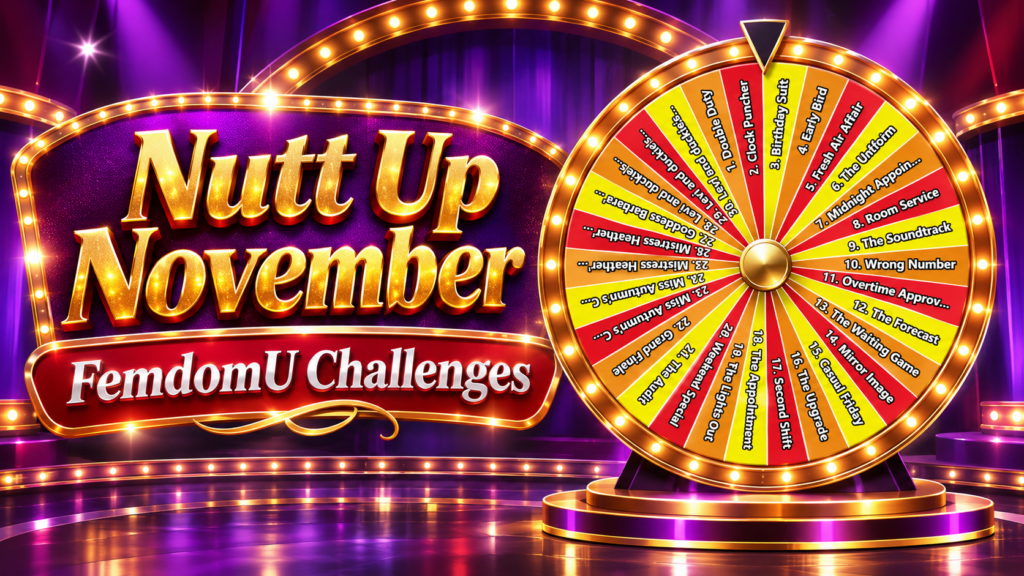
This is part of FemdomU Magazine’s Nutt Up November coverage. Learn more and discover how you can spin the Wheel of JOI daily!


















Cum production is a measured performance metric here. I’ve written about it before. To adequately supply the bar at our…
We thought of doing this - purposely - here. Unfortunately the Halloween party didn't work out - we are considering…
This submissive almost always finds Mistress Heather's articles to be precise, arousing, and oh so evocative. And she most definitely…
Consideration should be given to what the male should or should not say in an inspection. On one hand, an…
Great article Mizz Geena. All scenarios sound amazing. If I had to pick a favorite it would def be Scene…