






















How Marie Curie Redefined Scientific Authority
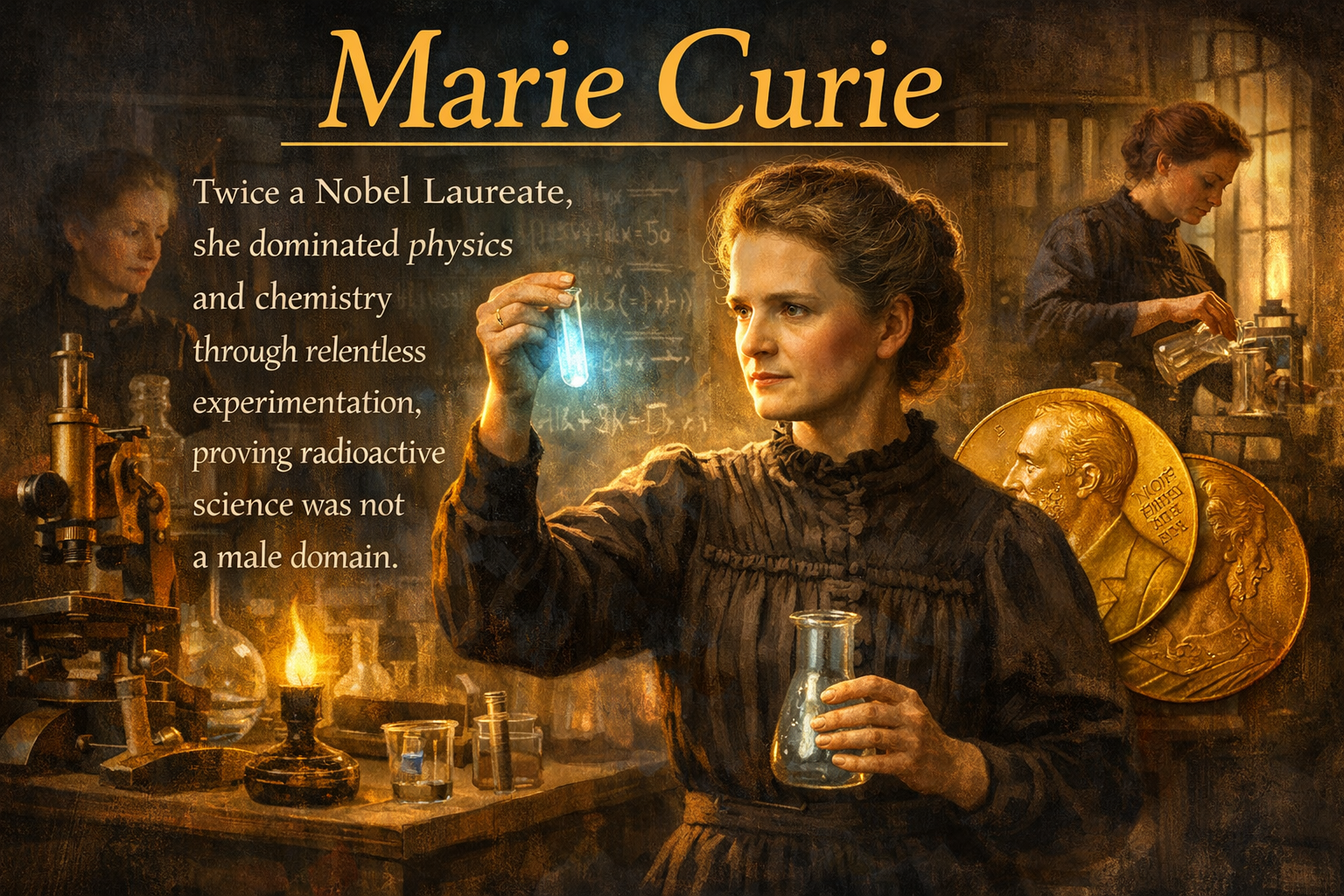
There are women who succeed within a system, and then there are women who bend the system until it has no choice but to reshape itself around them. Marie Curie did not ask for permission to enter science. She forced her way into it, endured it, and ultimately ruled over parts of it with a level of authority that even the men around her could not deny.
I find myself in awe of her, honestly. Not just because she was brilliant, but because she endured environments that were openly hostile, dismissive, and frankly undeserving of her presence. And she still outworked them.
Curie’s domination of science came through something deeply uncomfortable for the men around her. She was simply better.
She arrived in Paris with very little, studying at the University of Paris while living in near poverty. Men filled the lecture halls and laboratories, but she quietly absorbed everything, outperforming them in examinations and research. She was not loud. She did not posture. She let results do the talking, and those results became impossible to ignore.
Then came her work with radioactivity, a field she did not just participate in, but defined. She coined the very term. She isolated new elements, including Polonium and Radium, through painstaking, exhausting experimentation. The kind of work that required hauling heavy materials, stirring vats for hours, and enduring conditions that would have broken most people.
She did not delegate the hard parts. She did them herself.
I think that’s part of what makes her so… overwhelming to read about. There’s no illusion here. No charm offensive. No manipulation of image. Just relentless, disciplined labor paired with a mind that refused to accept limits placed on it by others.
When she was awarded the Nobel Prize in Physics, it was almost by accident that she was included. The initial nomination left her out, crediting only her husband Pierre Curie and Henri Becquerel. It took intervention to correct that omission. Even then, she stood on that stage as the first woman to ever receive the prize.
And she did not stop.
She later won a second, the Nobel Prize in Chemistry, becoming the first person ever to win Nobel Prizes in two different scientific fields. Not woman. Person.
That distinction matters.
Because by that point, it was no longer possible to frame her success as a fluke, or an exception, or something granted by association with a man. She had surpassed the framework entirely. She was the standard.
Even in her personal life, where scandal could have destroyed her reputation, she refused to bow. When attacked by the press over her relationship with physicist Paul Langevin, she did not retreat into shame. She continued her work. Continued her lectures. Continued being Marie Curie.
It’s hard not to feel… small, reading that. I mean that in the best way.
She didn’t dominate through force or theatrics. She dominated through endurance, intellect, and an almost frightening refusal to stop. The men around her could dismiss her, exclude her, even try to erase her. But they could not outproduce her. And in science, that’s the only authority that truly holds.
She didn’t just enter a male-dominated field.
She made it answer to her.













The little “Good Elf” notes are a sweet idea—personal praise feels way more meaningful than generic holiday gifts. I’d tuck…
Ty Eleven !! I can be quite the little collector!
You are just very persuasive, Mizz Geena!!
I think you mean - three so far! Great journey and pink really is a great colour Mayi.
Wow! i wouldn't have seen that coming and man the restraint you had for that. I guess that is one…