

























Anne Bonny – The Pirate Who Refused to Bow
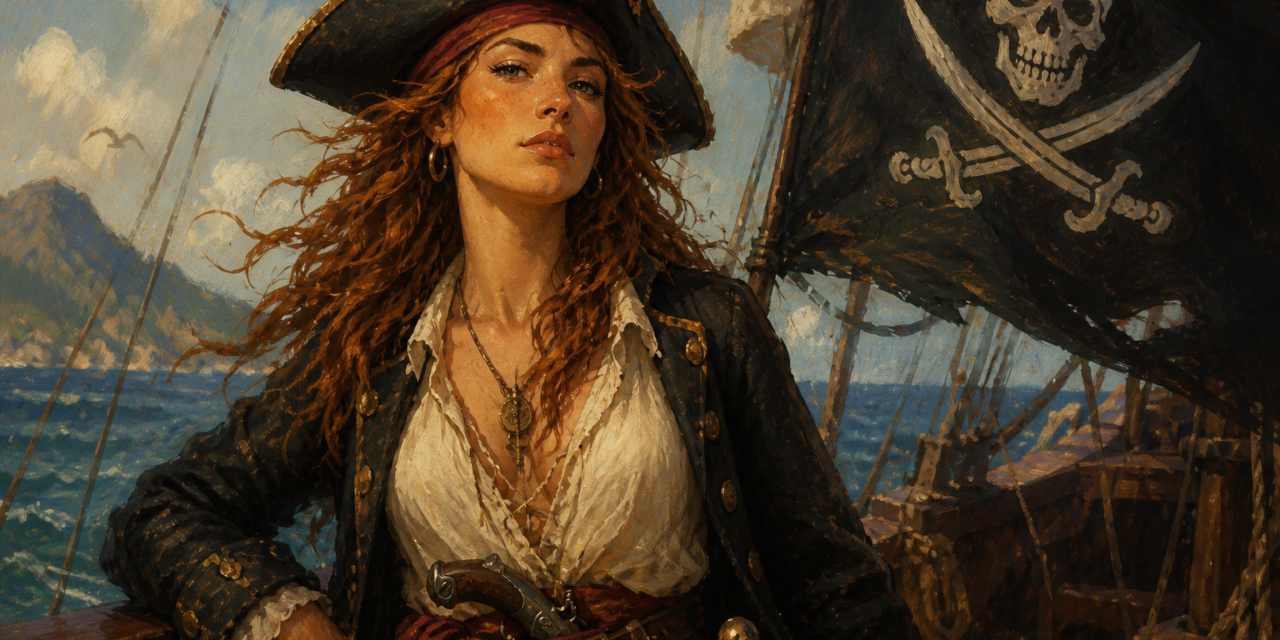
Anne Bonny did not merely survive in one of history’s most violent male worlds. She forced herself into it, armed herself within it, and terrified men inside it. In an era where women were expected to obey fathers, husbands, and kings, Anne Bonny chose piracy instead. She chose danger over obedience, violence over submission, and freedom over safety. Few women of the early eighteenth century shattered gender expectations as aggressively or as publicly as she did.
Born around 1697 in Ireland, Anne Bonny’s early life was already marked by scandal. She was believed to be the illegitimate daughter of attorney William Cormac and his servant Mary Brennan. To avoid disgrace, the family relocated to the American colonies, eventually settling near Charleston, South Carolina. Even as a young woman, Anne reportedly possessed a violent temper and fierce independence. Stories circulated that she once beat a servant girl nearly to death and stabbed a man who attempted to assault her. Whether every tale is fully accurate or not, her reputation for aggression followed her everywhere.
What makes Anne Bonny historically fascinating is not simply that she became a pirate. It is that she rejected every social role designed for women of her time. She married sailor James Bonny against her father’s wishes, only to quickly grow dissatisfied with domestic life. She despised weakness and conformity, and her marriage offered both. Eventually she abandoned her husband entirely and attached herself to the infamous pirate captain John “Calico Jack” Rackham.
That decision changed her life forever.
Anne did not remain quietly aboard ship as a hidden companion. She fought. Witness accounts described her wearing men’s clothing during battle, carrying pistols and machetes alongside the crew. Contemporary records repeatedly emphasize her ferocity during combat. Pirates were already feared figures across the Caribbean, but Anne Bonny earned particular notoriety because she displayed a level of aggression that shocked even hardened criminals.
She was not pretending to be a man in order to disappear. Quite the opposite. Anne Bonny made herself impossible to ignore.
One of the most compelling parts of her story involves fellow pirate Mary Read. The two women sailed together aboard Rackham’s ship, and both participated directly in piracy operations. Their partnership became legendary because they openly occupied a role society claimed women could not hold. They were not mascots or prisoners aboard the vessel. They were armed pirates participating in raids, intimidation, and violence.
Captured pirates later testified that Anne and Mary were often more courageous than the men around them.
That reputation became cemented during the crew’s final battle in 1720. When pirate hunters attacked Rackham’s ship near Jamaica, many of the male crew members reportedly hid below deck, drunk and terrified. Anne Bonny and Mary Read, however, continued fighting. According to surviving testimony, Anne screamed at the men to come up and defend themselves “like men,” furious that they had surrendered so easily.
It is one of the most remarkable moments in pirate history. A woman condemned by society as immoral and dangerous standing above armed cowards, demanding they fight with courage.
After capture, Rackham and most of the crew were sentenced to death by hanging. Anne Bonny famously delivered one final cutting remark to Rackham before his execution:
“If you had fought like a man, you need not have been hanged like a dog.”
That sentence alone explains why Anne Bonny still fascinates historians centuries later. She measured worth through strength, nerve, and action. She had no patience for weakness, especially from men who claimed authority.
Anne and Mary Read avoided immediate execution by “pleading the belly,” revealing they were pregnant. Mary Read later died in prison, likely from illness. Anne Bonny’s fate afterward remains uncertain. Some historians believe her wealthy father secured her release and that she eventually remarried and lived quietly in South Carolina. Others argue the records are too incomplete to know for certain.
But uncertainty only deepened the myth.
Anne Bonny became larger than history itself because she represented something extraordinarily dangerous for her era: a woman who openly rejected submission. She entered one of the harshest masculine environments imaginable and refused to behave according to anyone’s expectations. She drank, fought, swore, wielded weapons, and commanded fear during a time when women were legally and socially subordinate to men.
Piracy itself represented rebellion against empire and law. Anne Bonny added another layer to that rebellion by rejecting the very structure of womanhood imposed upon her. She did not ask permission to participate in history. She seized space inside it with violence and confidence.
Even now, centuries later, Anne Bonny remains one of the most recognizable female pirates in history because her story still feels disruptive. Men built the pirate world. Anne Bonny stormed into it anyway and refused to kneel.
She dominated history not because she behaved politely within the rules of her time, but because she openly rejected them.



















bambii, I appreciate your understanding that the cage is only the visible symbol, while the actual submission exists in the…
Great article! Last year duckie did a series on cunnilingus that we made a training primer for our boys. I'll…
Absolutely! In a few cases the dick alone is enough (like Cristopher here) but I agree with otta that its…
My group has talked about making "bare" permanent, by electroysis or laser treatments. We've chosen not to. For years now…
Hello, personally I find it normal and more appropriate that a submissive always presents himself in front of his Domina…