

























The Surprisingly Deep History of Facesitting

Why Facesitting Became Such an Iconic Femdom Image
Facesitting, also commonly called queening, is a sexual position in which one partner sits or kneels over another’s face, usually to receive oral stimulation. In Femdom, though, it has acquired a meaning much larger than the mechanics of oral sex. Facesitting brings together several of the ideas that define Female Domination: the woman physically above the man, female pleasure made central, the submissive placed in service, the Dominant controlling position and access, and an intimacy that somehow becomes more powerful because there is such an obvious hierarchy involved. That combination has made the image so recognizable that a woman sitting on a man’s face can communicate Femdom without a whip, collar, chastity cage, leather outfit, dungeon, or caption explaining what is happening.
As a submissive guy who absolutely loves being in that lower position, I understand its appeal without needing an art historian to explain it to me. But once I started looking into the history, I realized there is actually a fascinating story behind why facesitting became such powerful visual shorthand for Female Domination. It runs through erotic art, fetish publishing, comedy, pornography, censorship, political protest, and especially the work of one Japanese artist who spent decades turning the woman’s ass and the man’s position beneath it into something resembling an entire artistic philosophy.
The History Is Older Than the Name, but Be Careful With the Legends
Trying to identify the “first facesitting” in human history is nearly impossible, and there are plenty of internet articles willing to fill that gap with wonderfully confident stories. You will find claims that queening was practiced by aristocratic women in ancient Egypt, that wealthy Roman women used servants this way, that medieval noblewomen had special arrangements with lovers, and that Victorian ladies employed elaborate “queening stools” while gentlemen or servants waited underneath. Some contemporary sexual-health sources also claim that facesitting appears in ancient Egyptian, European, and Asian art, while a recent Vice treatment goes further and describes the practice as existing in ancient Rome and the Kama Sutra.
The problem is that the documentary trail is considerably less tidy than those summaries suggest. I could not find a strong primary historical source establishing an identifiable “first facesitting,” nor convincing evidence for some of the very specific aristocratic legends that are repeated online. Even modern sex educators writing about the history acknowledge that its exact origins are uncertain. That distinction matters. Oral sex is ancient, erotic art depicting women in sexually assertive positions is ancient, and humans have undoubtedly been arranging themselves in inventive sexual configurations for as long as humans have had sex. That does not mean we can confidently point at an Egyptian queen and announce that she invented queening.
What we can say is that facesitting belongs to a very old human tradition of non-penetrative sexuality and erotic imagery, while the particular cultural package we now call queening, especially its association with Female Domination, is much more modern. Even the language tells us something. “Facesitting” is wonderfully literal. “Queening” adds hierarchy. She is not merely the partner receiving oral attention. She becomes the queen, and the person underneath becomes, quite literally, her throne.
That metaphor would become enormously important.
The Throne Changes the Meaning
There is a reason “queening” is such an effective name. Facesitting automatically creates a vertical hierarchy that requires almost no interpretation. She is above. He is beneath. She occupies the dominant physical space while he accommodates her position. When oral service is involved, the arrangement becomes even more symbolically concentrated because her pleasure is the purpose of the position while his body becomes the means through which she receives it.
Humans have always attached authority to elevation. Kings and queens sit on raised thrones. Judges sit above their courtrooms. Speakers stand on platforms. We climb corporate ladders and talk about people being “above” or “beneath” us in hierarchies. Submission reverses that metaphor physically by putting someone on their knees, at another person’s feet, or flat beneath them. Facesitting compresses all of that symbolism into an intensely intimate sexual position.
That helps explain why specialized furniture eventually developed around it. Modern kink culture includes queening chairs, facesitting thrones, stools, and smotherboxes designed to place one person above another. Some are practical pieces of sexual furniture, while others deliberately resemble actual thrones because the symbolism is part of their appeal. The furniture did not create the fantasy. It made the fantasy architectural.
I find that fascinating because there are relatively few sexual positions for which people build a throne.
Female Pleasure Takes the Center
Facesitting also turns around one of the most stubborn conventions in heterosexual sexual culture: the assumption that intercourse and male orgasm constitute the main event.
The sexual script many of us inherit is still remarkably penis-centered. Penetration is “sex.” Other activities are “foreplay.” The man’s erection determines whether intercourse can happen, and his orgasm has traditionally been treated as the natural conclusion of the encounter. Female pleasure certainly exists within that script, but it has often been positioned as something surrounding the central act rather than defining it.
Facesitting refuses that arrangement.
The woman’s pleasure becomes the event itself. The submissive man’s sexuality is expressed through what he can provide rather than what he can receive. That is particularly compatible with service submission, in which obedience is expressed through useful acts performed for the Dominant. In a Femdom context, cunnilingus can therefore become more than oral sex. It becomes oral service, because the submissive is not simply participating in a mutually pleasurable activity. He may be serving because she wants pleasure, because she has instructed him to provide it, or because giving her pleasure is one of his established responsibilities.
That does not make his enjoyment irrelevant. Believe me, some of us are enjoying the assignment tremendously. But his enjoyment is not necessarily the organizing principle.
Her pleasure is.
That difference is a large part of why facesitting reads so immediately as Femdom.
Then Fetish Art Made the Image Unmistakable
If there is one artist who deserves enormous credit for establishing facesitting as an unmistakable visual language of Femdom, it is Japanese illustrator Namio Harukawa.
Born in Osaka in 1947, Harukawa began contributing artwork while still young to Kitan Club, an influential Japanese magazine associated with postwar sadomasochistic and fetish culture. He later published illustrations in magazines including SM Collector and SM Secret Novel, eventually developing a distinctive body of work centered on physically imposing women dominating comparatively diminished men. His official estate describes him as developing a new genre through his work, while the Japanese publisher Kawade Shobo Shinsha characterizes his career as more than fifty years devoted to an aesthetic of facesitting and male masochism.
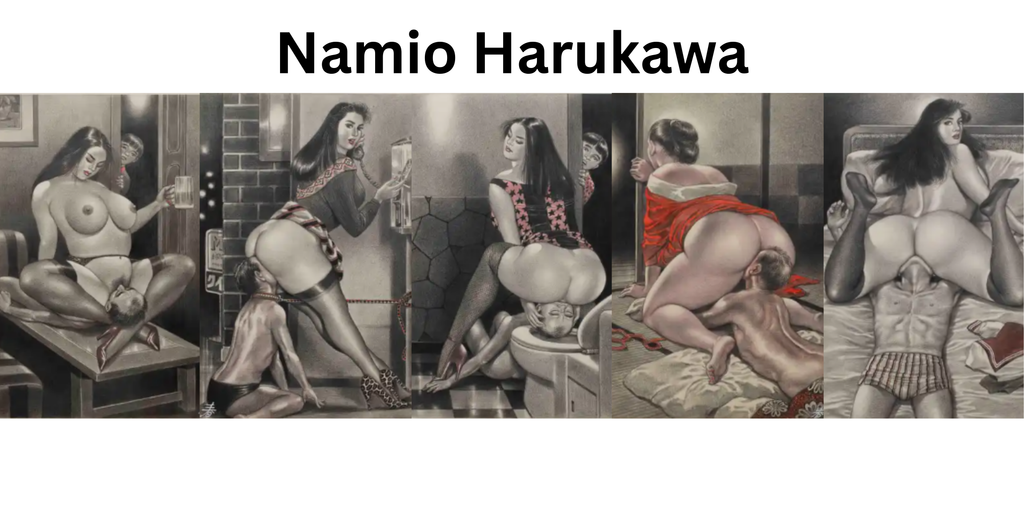
And when I say Harukawa liked facesitting, I am underselling this man’s commitment to the concept. His women are enormous presences. They are voluptuous, confident, beautifully dressed or partially dressed, and frequently almost serene about the men beneath them. His male subjects are often reduced visually to service objects, footrests, furniture, or faces disappearing underneath dominant female bodies. Facesitting, smothering, humiliation, bondage, and human furniture recur again and again.
That exaggeration is exactly what makes the work so effective. Harukawa was not documenting an ordinary sexual encounter. He was illustrating a fantasy of hierarchy. The woman does not merely happen to be on top. She visually overwhelms the composition. The man has not simply agreed to provide oral sex. His position communicates that serving her is the reason he is present.
By the 2000s, Harukawa’s work was receiving attention well beyond specialist fetish publications. His art was published internationally, exhibited at Paris’s Museum of Eroticism in 2013, and admired by figures including Madonna. A major 2019 Japanese collection was explicitly marketed as a definitive collection of his Femdom art and his decades-long fascination with facesitting.
That cultural legacy matters. Anyone looking at modern Femdom illustration, photography, memes, fetish advertising, or erotic artwork involving facesitting is looking at a visual vocabulary Harukawa helped establish.
He did not invent facesitting. He helped make it iconic.
Why Facesitting Works So Well as an Image
Harukawa’s success also points toward something much simpler: facesitting is extraordinarily efficient visual storytelling.
Imagine trying to communicate a Female Led Relationship in one photograph. You need context. A chastity cage tells you something sexual is happening but not necessarily who controls it. Bondage tells you somebody is restrained but not automatically why. A whip suggests BDSM but can be wielded by anyone. A collar establishes ownership only if the viewer understands the symbolism.

Facesitting barely needs explanation.
A woman occupies the upper and usually dominant part of the image. A man is underneath her. Depending on the composition, portions of him may literally disappear behind her body. His face, ordinarily one of the most important elements of a portrait, can become visually secondary while her body becomes central. The position can therefore communicate female authority, male submission, oral service, intimacy, female sexual agency, and physical control in a single frozen frame.
That is why it works so beautifully in Femdom artwork. The hierarchy is built into the geometry.
Pop Culture Usually Laughs Before It Understands
Mainstream culture has had a more complicated relationship with facesitting. When it escapes pornography or fetish art, it is frequently treated as a joke, an outrageous sexual reference, or something naughty enough that simply mentioning it provides the punchline.
The most famous example is probably Monty Python’s “Sit on My Face.” Eric Idle wrote the short song for Monty Python’s Contractual Obligation Album in 1980, setting sexually suggestive lyrics to the melody of the wholesome 1930s song “Sing As We Go.” It later appeared in Monty Python Live at the Hollywood Bowl, released as a film in 1982, and returned in subsequent Python performances, including the group’s 2014 reunion shows.
The joke works precisely because facesitting was already recognizable enough to be transgressive. Python took something considered private, kinky, and indecent and paired it with cheerful British musical nostalgia. That collision between respectability and explicit sexual enthusiasm became the joke.
American regulators apparently understood the reference perfectly well. In the early 1990s, San Diego radio station KGB-FM faced an FCC penalty after broadcasting “Sit on My Face” along with another sexually suggestive parody. Contemporary reporting described the proposed $25,000 penalty as, at that time, the largest single fine for indecent programming.
Think about the strange cultural journey there. A sexual position associated with oral pleasure and kink became a British comedy song, which became a concert routine, which became a radio censorship case in the United States.
Facesitting had entered popular culture, but largely through comedy and scandal.
Pornography Made It a Category, Femdom Made It a Symbol
Pornography pushed the image further by turning facesitting into a recognizable category of sexual content. Within Femdom pornography in particular, the position could easily be intensified through bondage, commands, humiliation, worship, smothering fantasies, human furniture, or exaggerated presentations of the woman’s physical dominance.
This is where facesitting acquired two somewhat different cultural identities. In mainstream sexual advice, it increasingly became another oral-sex position, often described with the softer and more flattering word “queening.” In fetish culture, however, facesitting could retain a much stronger emphasis on hierarchy. She is not merely receiving cunnilingus in a convenient position. She is sitting on him. Depending on the fantasy, his comfort, mobility, access, and even visibility are secondary to her authority.
Modern mainstream publications demonstrate how far the practice has traveled. Men’s Health, Cosmopolitan, sexual-health magazines, and other non-fetish publications now publish straightforward guides to queening and facesitting. Something that once existed mainly in underground erotica and fetish imagery can now appear beside ordinary articles about relationships and sexual communication.
Yet when the same position appears in Femdom imagery, we still recognize the older symbolic vocabulary immediately.
Queen. Throne. Service. Hierarchy.
That symbolism survived mainstreaming.
The Day Facesitting Became Political
Perhaps the strangest chapter in facesitting’s cultural history came on December 12, 2014, when people gathered outside the British Parliament and deliberately turned it into an act of political protest.
Changes to British regulations governing online pornography had effectively brought UK-produced video-on-demand pornography under restrictions similar to those applied to physical R18 video releases. Facesitting was among the activities campaigners said were caught by the new rules. Protesters argued that the restrictions were arbitrary, discriminatory, and particularly hostile toward sexual practices associated with female pleasure and alternative sexuality.
So they responded in the most British way imaginable. They held a mass facesitting demonstration outside Parliament.
Participants simulated facesitting on mats in Parliament Square. One submissive participant famously incorporated a snorkel into the demonstration, mocking the suggestion that the activity was inherently too dangerous to depict. The protesters also sang Monty Python’s “Sit on My Face,” neatly connecting a 1980 comedy song with a twenty-first-century protest over pornography regulation.
It sounds ridiculous, and deliberately so. But academics subsequently studied the protest seriously. Jacki Willson, writing in Porn Studies, described how the protest used bawdy humor, fetish clothing, class imagery, and English pantomime traditions to place the spectacle of the sexually assertive woman and her desires at the center of public attention. Another scholarly analysis examined the way humor functioned politically in the facesitting protest and later sex-worker demonstrations.
There is an image from that protest that captures the whole cultural collision beautifully: a woman styled like an upper-class English lady, complete with tailored clothing and an air of respectability, casually drinking tea while positioned over a male protester. Researchers specifically discuss the deliberate use of upper-class feminine imagery as a way of mocking conventional sexual respectability.
At that point, facesitting had traveled far beyond being merely a sex position. It had become a symbol people could use to argue about censorship, women’s pleasure, pornography, bodily autonomy, class, sexual freedom, and who gets to decide what kinds of consensual adult sexuality are respectable enough to be shown.
There Is Something Politically Awkward About Her Pleasure
I think the 2014 controversy reveals something important about why facesitting remains culturally provocative. It is not merely that the position is sexual. Popular culture is overflowing with sex. What is unusual is the arrangement of sexual power.
The woman is not displayed primarily for male consumption while a man receives pleasure. She is visibly taking up space, directing the physical arrangement, and receiving sexual attention. In Femdom imagery, the man may be present almost entirely because he is useful to her.
That is a reversal of an extremely familiar sexual script.
Academic discussion of BDSM and gender has noted that BDSM can both reproduce and deliberately challenge conventional associations between masculinity and dominance and between femininity and submission. Facesitting offers an almost cartoonishly clear example of the reversal. Nobody needs to ask which person has been visually elevated.
There is also something wonderfully unapologetic about it. The woman does not need to make herself physically smaller. She does not need to pretend that wanting oral attention is incidental. She takes the position that works for her, and the submissive adapts himself accordingly.
Which brings me to the part of this article I am significantly more qualified to discuss…
Why I Would Be Under Her All the Damn Time
I fucking love facesitting. There, my scholarly credentials are officially on the table. And if there is such a thing as an experienced facesittee, I think I’ve earned the title. I’ve spent hundreds, probably thousands, of hours over the years with a woman sitting on my face, and I honestly couldn’t begin to count how many women I’ve been privileged to serve that way. Different women, different bodies, different preferences, but I’ve always been pretty damn happy about where I ended up: flat on my back, underneath her, exactly where I’m useful.
I already love providing oral service to women, and facesitting adds a physical hierarchy that makes the experience particularly satisfying to the submissive part of my brain. There is something wonderfully uncomplicated about being underneath a woman and knowing that, for that period of time, my attention has exactly one destination. I am not wondering whether I should initiate something else, whether she expects intercourse, or whether I should be pursuing my own orgasm. I have an assignment. She has put herself where she wants me, and my job is to concentrate on her pleasure.
For me, that is not disappearing from the sexual experience. It is the opposite. I feel incredibly involved because I understand exactly what my role is.
I also love the symbolism that I have spent the rest of this article pretending to analyze objectively. Yes, I like being beneath her. Yes, I like the fact that she is physically occupying the superior position. Yes, I like feeling useful. Yes, there is something incredibly satisfying about a woman deciding that my face is where she wants to sit because she expects me to take care of her.
Apparently Namio Harukawa and I would have had plenty to discuss.
If my owner permitted it, I would probably volunteer for facesitting far more often than any reasonable household schedule could accommodate. I have suggested that I could simply be made available whenever required. Unfortunately, there are apparently expectations involving employment, housework, errands, sleep, and other completely unnecessary interruptions to my true calling.
I maintain that this represents a failure to properly allocate available submissive resources.
Joking aside, the position captures something I genuinely love about submission. It makes her desire more important than my ego. I do not need to be the sexual star. I do not need everything oriented around my cock. I do not need an orgasm at the end to determine whether something “counted” as sex. I can be useful, attentive, obedient, and intensely involved while her pleasure remains the entire point.
That is not a consolation prize to me. That is exactly where I want to be.
From Underground Fetish to Femdom Icon
Facesitting did not become an iconic Femdom image because somebody officially declared it one. It accumulated meaning.
Oral sexuality gave it intimacy. The upper and lower positions gave it hierarchy. The idea of queening gave it the language of royalty. Service submission made female pleasure its purpose. Fetish artists, most importantly Namio Harukawa, exaggerated its proportions until the woman on top and the man disappearing beneath her became unmistakable visual symbols of Female Domination. Pornography repeated the image. Monty Python made mainstream audiences laugh about it. Regulators censored references to it. British activists eventually performed it outside Parliament as an act of protest.
After all that history, perhaps it is unsurprising that facesitting can now communicate Femdom in a fraction of a second.
For me, though, its appeal remains much simpler than its cultural history. It places her pleasure above me, both figuratively and literally. It gives me a useful purpose. It makes the hierarchy unmistakable without requiring either of us to say a word.
Every queen deserves a throne. And some of us are perfectly happy being furniture.









FAQ
Is facesitting the same thing as queening?
The terms are commonly used interchangeably, although “queening” carries stronger connotations of female authority and elevation. Facesitting describes the physical position, while queening can emphasize the woman occupying a queen-like position above her partner.
Is facesitting inherently Femdom?
No. People can enjoy facesitting without any Dominant/submissive dynamic whatsoever. Within Femdom, however, its physical hierarchy and focus on female pleasure make it particularly easy to incorporate into power exchange.
How old is facesitting?
There is no reliable historical date for its invention. Modern sources sometimes attribute it to ancient Egypt, Rome, Asia, or medieval aristocracy, but many specific origin stories are poorly documented. It is safer to say that oral sex and sexually assertive female imagery are ancient, while facesitting’s modern identity as “queening” and a recognizable Femdom motif developed much later.
Who was Namio Harukawa?
Namio Harukawa was a Japanese fetish illustrator born in Osaka in 1947 who became internationally known for images of voluptuous, dominant women and submissive men. Facesitting, smothering, human furniture, and exaggerated female physical dominance became signatures of his work, making him particularly influential in the visual culture of Femdom.
Has facesitting appeared in mainstream popular culture?
Yes. The best-known example is Monty Python’s 1980 song “Sit on My Face,” which later appeared in live performances and film. The song itself became the subject of American broadcast-indecency enforcement. Facesitting has also moved into mainstream sexual-health and lifestyle publications, although pop culture has historically been more likely to treat it as comedy, shock, or transgression than as ordinary sexuality.
What was the 2014 facesitting protest?
On December 12, 2014, sex workers, fetishists, and free-expression campaigners demonstrated outside the British Parliament against new pornography regulations. Participants staged a mass facesitting protest and sang Monty Python’s “Sit on My Face.” The demonstration subsequently became the subject of academic research examining pornography regulation, feminism, sexual politics, protest, and humor.
Why is facesitting so closely associated with Female Domination?
It combines several recognizable Femdom themes in one position: the woman is physically elevated, the submissive is beneath her, her pleasure becomes central, his role becomes service-oriented, and she has considerable control over positioning. Visually, very little additional context is required to establish the hierarchy.
Is facesitting always humiliating for the submissive?
Not at all. It can be used for humiliation, but it can also represent worship, affection, intimacy, service, obedience, or simply female-centered oral sex. The meaning comes from the dynamic established by the participants.

















Thank you Autumn. No man should be confused about his place with you. I would say naked, obedient, useful and…
Hi Duckie. I really hope you have fun on your vacation. Enjoy the trip and the festivities but don't forget…
Well -- no Reason, but maybe just a little bit of Rhyme?
More brilliance from Miss Autumn. "They crave the reality of me after a long day, after a workout, after hours…
A weekly review and look ahead meeting in an FLR is an excellent idea. Your point of keeping the meeting…