






















Nancy Grace Roman Was The Woman Who Gave Humanity a Better View of the Universe
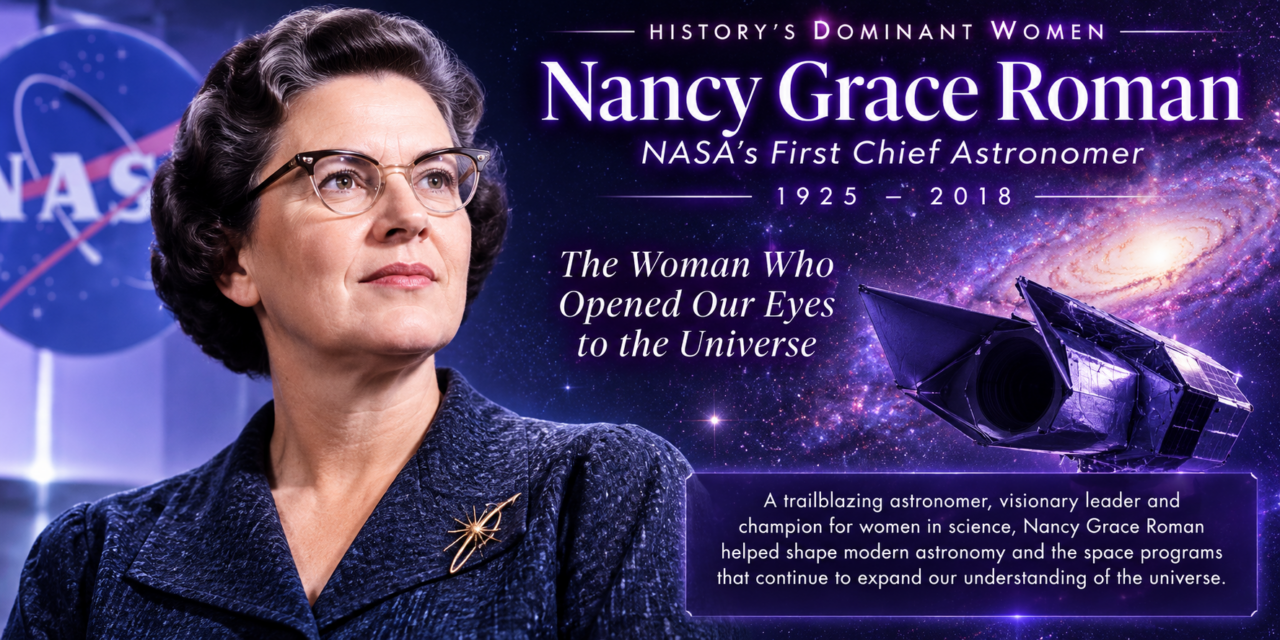
Nancy Grace Roman spent much of her early life being told, directly and indirectly, that science belonged to men. She responded by becoming one of the most influential women in the history of American astronomy.
Roman was NASA’s first Chief of Astronomy and the first woman to hold an executive position at the agency. She helped establish NASA’s space astronomy program, fought for ambitious scientific projects at a time when their costs made them difficult to sell, and became one of the driving forces behind the telescope that would eventually become Hubble. Her contribution was so important that she became widely known as the “Mother of Hubble.”
There is something wonderfully appropriate about Roman’s place among History’s Dominant Women. She did not dominate through celebrity, scandal, or a larger-than-life public personality. Her authority came from knowledge, persistence, organization, and an ability to get enormously complicated things done. In a scientific establishment overwhelmingly controlled by men, Nancy Grace Roman became the woman helping decide where American astronomy would go next.
A Girl Who Wasn’t Supposed to Become an Astronomer
Nancy Grace Roman was born May 16, 1925, in Nashville, Tennessee. Her father was a geophysicist and her mother was a music teacher, and Roman developed an intense curiosity about the natural world while still young. By age eleven, she had organized an astronomy club with classmates. By seventh grade, she already knew that she wanted to become an astronomer.
Unfortunately, adults were also beginning to tell her what girls supposedly could and could not do.
Roman later recalled a high school guidance counselor questioning why a girl would want to take another year of algebra instead of Latin. At Swarthmore College, where she studied astronomy, she encountered similar skepticism. The head of the physics department was known for discouraging women from pursuing physics, although Roman eventually convinced him that she might actually succeed.
She did more than succeed.
Roman earned her bachelor’s degree from Swarthmore in 1946 and completed a doctorate in astronomy at the University of Chicago in 1949. She then conducted research at the university’s Yerkes Observatory, studying stars and developing the scientific reputation that would eventually carry her far beyond academia.
Her intelligence was not the problem. The opportunities available to women were.
When the Boys’ Club Wouldn’t Make Room
Roman remained at the University of Chicago for several years, teaching and conducting research, but eventually confronted the realities facing women who wanted permanent academic careers.
The prospects were terrible.
Roman later observed that women had worked at the institution for years without receiving the same opportunities for advancement available to men. At the time, there was only one tenured female astronomer in the United States.
Roman could have remained and hoped that the system would eventually change. Instead, she changed direction.
In 1955, she joined the U.S. Naval Research Laboratory, where she entered the emerging field of radio astronomy. She eventually became head of its microwave spectroscopy section, gaining valuable experience not only as a scientist but as someone capable of managing scientific programs and working with engineers.
Then, in 1959, came an opportunity that would change both Roman’s career and American astronomy.
NASA was barely a year old.
Jack Clark, an official at the new agency, asked Roman whether she knew someone who might be interested in creating a program for space astronomy.
Roman knew exactly the woman for the job.
Herself.
The Woman in Charge at NASA
Roman joined NASA in 1959 and became its first female executive. The following year, she became Chief of Astronomy and Relativity in NASA’s Office of Space Science.
The girl who had been questioned for wanting to study algebra was now helping determine the direction of American space science.
Roman occupied an unusually powerful position. She worked between astronomers dreaming about what might be discovered, engineers determining what could actually be built, NASA administrators deciding what projects the agency should pursue, and politicians controlling the money required to make those projects possible.
That required more than scientific knowledge. It required judgment, diplomacy, stubbornness, and the ability to tell extremely accomplished people that not every idea could receive funding.
Roman helped develop programs involving satellites and rockets and oversaw grants supporting astronomical research. She listened to the scientific community, identified priorities, and helped transform proposals into programs that NASA could realistically pursue.
In an era when the upper levels of American science and government were overwhelmingly male, men increasingly found themselves explaining their ideas, requesting resources, and working within programs overseen by Nancy Grace Roman.
She had earned her seat at the table.
Then she helped put a telescope above the Earth.
Becoming the Mother of Hubble
The idea of placing a large astronomical telescope in space did not originate with Roman. Astronomers had discussed the possibility for years, and astrophysicist Lyman Spitzer became one of its most important early advocates.
Roman’s great contribution was helping turn that scientific dream into an actual government program.
A telescope above Earth’s atmosphere offered enormous advantages. The atmosphere distorts incoming light and blocks portions of the electromagnetic spectrum. A sufficiently powerful telescope operating in space could observe the universe with a clarity impossible for many Earth-based instruments.
The science was compelling.
The price tag was another matter.
Roman spent years building support for what became the Large Space Telescope project and eventually the Hubble Space Telescope. She brought astronomers together to determine what they actually needed from such an instrument. She worked with engineers to establish what was technologically achievable. She helped define scientific requirements and became an important connection between the astronomical community, NASA leadership, and Congress.
This is where Roman’s particular form of dominance becomes so impressive.
She did not personally build Hubble, nor did she single-handedly invent the concept. Thousands of people would ultimately contribute to the observatory. Roman’s power was her ability to make the enormous institutional machinery necessary for such a project begin moving in the same direction.
Scientists needed to agree upon priorities. Engineers needed realistic specifications. NASA needed a program it could defend. Congress needed convincing that taxpayers should fund it.
Roman helped make all of those things happen.
Her colleague Ed Weiler later popularized the nickname that would follow her for the rest of her life: the “Mother of Hubble.”
Authority Without the Performance
Nancy Grace Roman is particularly interesting because there is very little need to embellish her story.
There are no notorious affairs or great sexual scandals to add a risqué twist to her biography. There is no evidence that she viewed her professional relationships with men through anything resembling the female-dominant lens we sometimes explore in this series.
What actually happened is more satisfying.
Roman entered institutions built almost entirely around male authority and acquired genuine authority within them.
She controlled programs and influenced funding. She evaluated proposals from scientists. She worked with engineers and administrators. She represented astronomical priorities inside NASA and helped sell those priorities to the federal government.
The sexism did not magically disappear when she became successful. Roman recalled using “Dr.” with her name because otherwise people sometimes failed to understand that she was the scientist or official they were expecting. Her accomplishments could take her into the upper levels of NASA, yet the assumptions surrounding women remained stubbornly ordinary.
Roman had an appropriate response to that resistance: stubbornness of her own.
She later reflected that if she had not been stubborn, people would have talked her out of pursuing science long before she ever reached NASA.
Fortunately, they failed.
Hubble Proved Her Right
Roman retired from NASA in 1979, more than a decade before the Hubble Space Telescope finally launched aboard the Space Shuttle Discovery in April 1990.
The telescope initially suffered from a famously flawed primary mirror, but astronauts installed corrective optics during a servicing mission in 1993. Hubble subsequently became one of the most scientifically productive and publicly recognizable instruments ever constructed.
Its observations transformed astronomy.
Hubble helped scientists refine measurements of the age and expansion of the universe. It provided extraordinary views of galaxies billions of light-years away, observed stellar birth and death, contributed to research on black holes, helped characterize planetary systems, and produced images that changed the public’s conception of what the universe looked like.
Roman had spent years arguing that humanity needed a great observatory above Earth’s atmosphere.
Hubble provided the answer.
She was right.
Building More Than One Telescope
Hubble understandably dominates discussions of Roman’s career, but her influence extended much further.
Roman helped establish the foundations of NASA’s space astronomy program itself. During her years at the agency, she supported and helped develop multiple astronomical missions and helped create the institutional expectation that some of humanity’s most powerful observatories should operate beyond Earth’s atmosphere.
That philosophy eventually produced NASA’s Great Observatories program, including Hubble, the Compton Gamma Ray Observatory, the Chandra X-ray Observatory, and the Spitzer Space Telescope.
Roman therefore did more than champion a successful telescope. She helped normalize an entirely new way of conducting astronomy.
After leaving NASA, she remained involved in scientific work. She consulted on astronomical catalogs, worked at NASA’s Goddard Space Flight Center’s Astronomical Data Center, and continued supporting science and education.
Roman lived long enough to see the observatory she had championed become legendary.
She died on December 25, 2018, at the age of 93.
But history was not finished attaching Nancy Grace Roman’s name to the stars.
The Telescope That Bears Her Name
In 2020, NASA announced that the Wide Field Infrared Survey Telescope would be renamed the Nancy Grace Roman Space Telescope in her honor.
It was an extraordinary tribute.
Roman had spent her career making the case that ambitious space telescopes were worth building. Decades later, NASA placed her name upon another major space observatory designed to investigate some of astronomy’s greatest mysteries, including dark energy, the structure and evolution of the universe, and planets beyond our solar system.
The symbolism is difficult to improve upon.
A girl who had once been questioned for wanting to study mathematics became a woman whose name would travel into space aboard one of humanity’s most advanced astronomical observatories.
How Nancy Grace Roman Dominated History
Nancy Grace Roman dominated history because she did considerably more than overcome discrimination.
She gained authority.
That distinction matters.
There are countless inspiring stories about women who became the first woman allowed into a particular room. Roman walked into the room and eventually became one of the people deciding what everyone inside it was going to accomplish.
She helped establish NASA’s space astronomy program. She controlled resources, coordinated scientists and engineers, navigated federal bureaucracy, and spent years championing the project that became Hubble. She demonstrated that leadership in science is not limited to making discoveries personally. Sometimes the person who changes history is the one capable of creating the institution, securing the resources, and bringing together the people who will make those discoveries possible.
As a submissive man writing these biographies, I find Roman’s particular kind of authority especially worthy of admiration. She did not have to humiliate men or proclaim female superiority to demonstrate her power. She simply became extraordinarily good at a job men had rarely permitted women to hold, and then exercised the authority that came with it.
Men told Nancy Grace Roman that science wasn’t a woman’s world.
She ultimately helped decide how humanity would explore other worlds.
That is how Nancy Grace Roman dominated history.




















The “Good Elf” affirmations are a cute way to make the 12 days feel personal without overcomplicating it. free ai…
Hi eleven. Appreciate the comments. I have had a number of cages over the years, but this is the first…
Hi eleven. Sounds like we have similar experiences with the metal vs. other types of cages. c.
Great article Duckie! Thank you for the how to instructions as well. I hope they don’t come in handy.
duckie, this gave me a smile. I do, however, think a short instructional video would have been useful. Perhaps we…