













Emmeline Pankhurst Did Not Ask… She Demanded
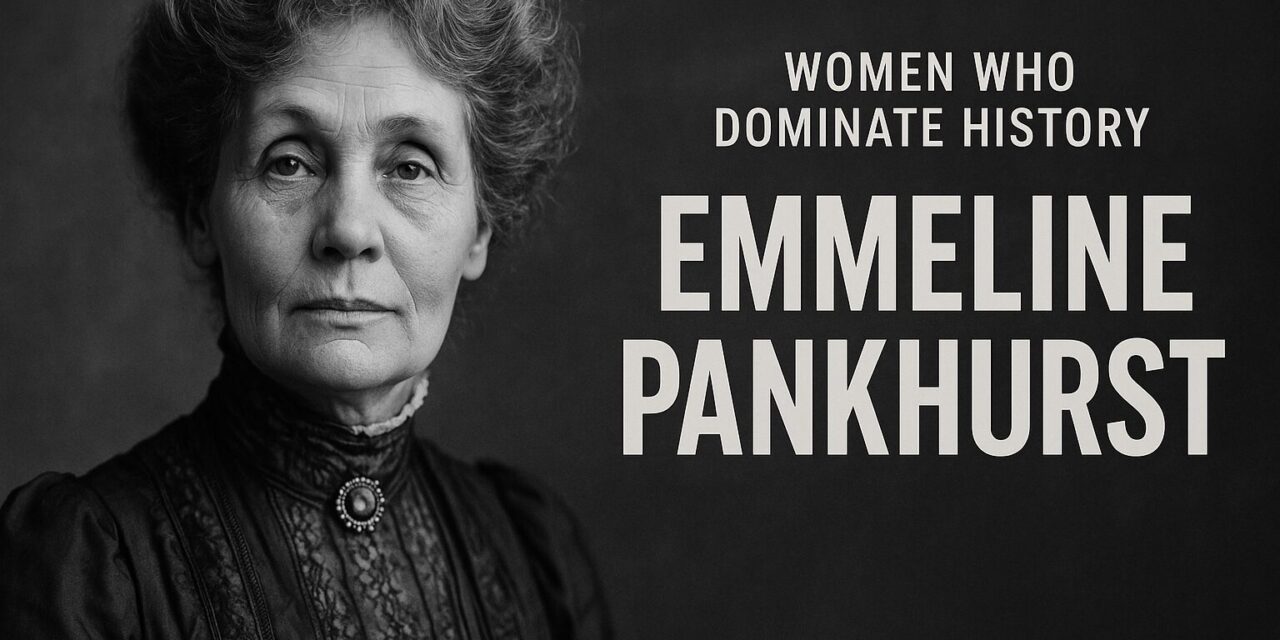
Born on July 15, 1858, Emmeline Pankhurst was not simply a political activist—she was a force of nature, a dominant will wrapped in Victorian lace, unafraid to shatter every expectation society placed on women. Where polite requests for the vote had failed, she brought confrontation. Where quiet protests were ignored, she brought noise, fire, and chains. She made history bend to her voice, and she made the men in power tremble before the women they had tried to silence.
Pankhurst’s most explosive legacy lies in her founding of the Women’s Social and Political Union (WSPU) in 1903. Unlike previous suffrage campaigns, the WSPU wasn’t interested in waiting patiently. Their motto? “Deeds, not words.” And oh, did she mean it. Under her iron leadership, the WSPU adopted militant tactics—hunger strikes, smashing windows, burning mailboxes, storming Parliament itself. Anything to make the ruling men see that their dominance would not go unchallenged.
Emmeline was arrested countless times, and each time she returned to the fight stronger, hungrier, more determined. When imprisoned women were force-fed during hunger strikes, Emmeline turned the brutality into a media spectacle that humiliated the British government. The state couldn’t figure out what to do with a woman so fearless, so unwavering, so unbending. She weaponized her femininity as a challenge, not a plea. She turned her body into a battleground and refused to retreat.
What makes her domination so profound is not just that she demanded political power—it’s that she taught women they had the right to seize it. Her leadership wasn’t gentle. It wasn’t motherly. It was commanding. She ruled her movement with the same authority men had long assumed belonged only to them. She raised daughters who carried on the cause, raised hell in the House of Commons, and raised a generation of women who refused to be content with crumbs.
Was she controversial? Absolutely. And gloriously so. Emmeline didn’t want to be liked. She wanted to win. And she did.
In 1918, after years of fierce rebellion, women over 30 finally won the right to vote in Britain. It was just the beginning—but it was proof that her methods worked. And in 1928, just weeks after her death, full suffrage was granted to women on equal terms with men.
Emmeline Pankhurst didn’t just march through history. She stormed it. She chained herself to it. She bled for it. And she left behind a world forever altered by her will.
Madam Pankhurst, you didn’t ask for power. You took it. And for that, I kneel in awe.







Heey bgl, are you back? I remember reading this last year, pretty sure it got the job done if you…
Very interesting article Goddess Barbara. I always appreciate how insightful you are, and how you relate everything to nature is…
Boy, recalibrate yourself: you have NO PRIVATE PARTS!! In fact, they're not even your's. They belong to her to serve…
Thank you nurse jessica showing proper guidance of cleaning penis. It is really a eye opener not only for submissive…
As usual Nurse Jessica, your article is spot on. This is my first Locktober, and maybe my suggestion has been…