


















Mary Shelley and the Woman Who Created the Monster
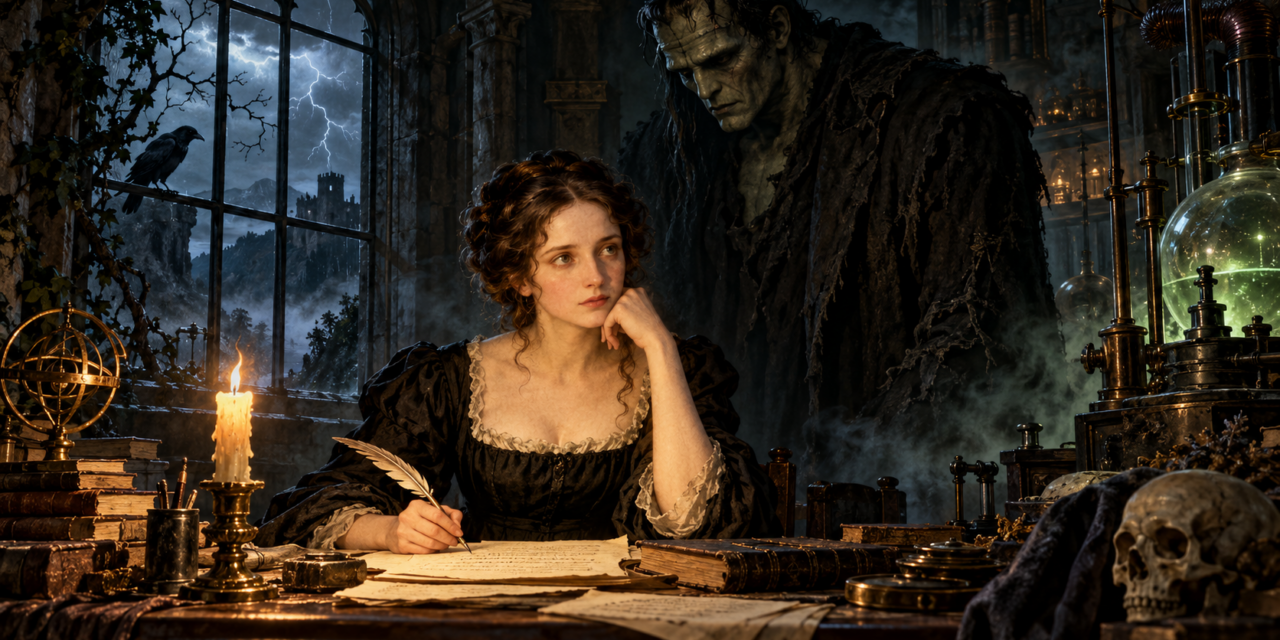
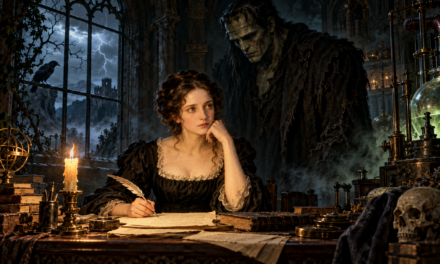
On a dark, rain-soaked summer beside Lake Geneva, a young woman sat among poets and storytellers while the weather kept them indoors. Lord Byron proposed a contest: each person would write a ghost story. The others began. Mary Godwin struggled for an idea.
Then, as she later recalled, an image came to her: a pale student of forbidden arts, kneeling beside the thing he had assembled. The body stirred. The dead seemed to answer the living.
That waking vision became Frankenstein; or, The Modern Prometheus, a novel that has haunted readers for more than two centuries. Mary Shelley did not simply give us a monster. She gave us the creator who abandons him, and a story that asks what happens when ambition outruns responsibility.
A daughter raised among ideas
Mary Wollstonecraft Godwin was born in London in 1797. Her parents were two of the era’s most challenging thinkers: political philosopher William Godwin and writer Mary Wollstonecraft, whose A Vindication of the Rights of Woman argued for women’s education and equality. Mary’s mother died shortly after giving birth, so Mary grew up with her mother’s name and reputation but without knowing her. Her father’s household surrounded her with books and debate, even as the world outside offered girls far fewer chances to shape public life.
Mary’s own life refused to stay inside conventional boundaries. As a teenager, she fell in love with the poet Percy Bysshe Shelley, who was already married. They traveled together in Europe and eventually married in 1816. Their private choices drew scandal, but Mary was not simply a footnote in a poet’s dramatic life. She was developing into a writer with her own imagination, discipline, and voice.
That distinction matters. The young woman who created Frankenstein was surrounded by famous men, but the novel that outlived them was hers.
The summer that gave birth to a monster
In 1816, Mary, Percy, and others were staying near Byron’s villa in Switzerland. The summer was unusually wet, and the group spent long stretches indoors reading ghost stories and talking late into the night. Byron’s challenge gave Mary a starting point, but she turned it into something far larger than a fireside fright. She began writing what became a novel, published anonymously in 1818. Percy Shelley wrote its preface, which helped leave some early readers uncertain about who had created it.
The creature at the center of Frankenstein is often called Frankenstein, but that is the name of his maker, Victor Frankenstein. The creature is never given a personal name. He is brought into life through Victor’s experiments, then rejected by the man who made him. Intelligent and yearning for connection, he is met with fear and cruelty. The horror grows from that abandonment as much as from the unnatural act of creation.
Mary’s story asks a question that still feels dangerous: if you bring something into the world, what do you owe it? Victor wants the glory of discovery, but recoils from the vulnerable life he has made. His failure of care unleashes consequences he cannot command.
That is one reason Mary Shelley’s work still dominates horror. The terror is not only the lightning, the laboratory, or the stitched-together body. It is the human decision to create, then turn away.
A woman’s imagination that changed the genre
Frankenstein is often described as a foundational work of science fiction, and it helped shape Gothic horror for generations. Shelley used scientific speculation to explore ambition, isolation, power, and responsibility. The novel’s questions have followed each new era of technology: What should people attempt? Who bears the cost? Does discovery excuse neglect?
Mary’s achievement is especially striking because the first edition did not prominently name her as its author. The story entered the world without her name on the title page, while its ideas began to travel. In 1831, she revised the novel and wrote an introduction recounting its famous origin. By then, the work had begun its transformation into a cultural legend.
And the legend escaped the book. Stage adaptations, films, illustrations, and countless retellings made “Frankenstein” a word people use even when they have never read the novel. The creature’s face became one of horror’s most recognizable images. Mary had imagined him as a complex, eloquent being; popular culture often reduced him to a lumbering figure. Yet even that simplified image testifies to the force of her creation. Her story became so powerful that the world kept remaking it.
More than one haunting
Mary Shelley’s career did not end with the creature. She wrote other novels, including Valperga, The Last Man, Lodore, and Falkner, as well as travel writing and biographies. The Last Man, published in 1826, imagines a future devastated by plague, showing how readily she could turn from Gothic creation to the collapse of society itself.
After Percy Shelley died in 1822, Mary raised their surviving child and worked to preserve her husband’s writing and reputation. She continued writing to support herself and edited collections of Percy’s poetry. That labor deserves attention in its own right: she was a novelist, editor, biographer, and keeper of a literary legacy, working in a world that often treated women’s authorship as secondary.
Mary Shelley died in 1851, but she did not vanish into the shadow of the monster. She remains the author who made a young man’s forbidden experiment into a lasting moral reckoning. Victor Frankenstein believed he could command life. Mary Shelley understood the more frightening truth: creation brings responsibility, and no one can outrun the consequences of refusing it.
I admire the woman who looked into the dark and gave it a voice. Her creature still walks through our stories, but it is Mary Shelley’s imagination that keeps the candle burning.
Sources
- Shelley-Godwin Archive, Frankenstein chronology and manuscript resources.
- British Library, Mary Shelley’s Frankenstein.
- National Library of Medicine, Frankenstein: Penetrating the Secrets of Nature.











duckie, it would be wonderful if all women could have a boy as obedient, helpful, and useful as you are.
Brandon, I do love how she's using you to help her keep Levi in line. That boy needs an extra…
Good boy Thanuj. You're showing great retstraint for a young man on his first go with being caged.
Heey bgl, are you back? I remember reading this last year, pretty sure it got the job done if you…
Very interesting article Goddess Barbara. I always appreciate how insightful you are, and how you relate everything to nature is…