






















The Piano Was Her Throne – Nina Simone
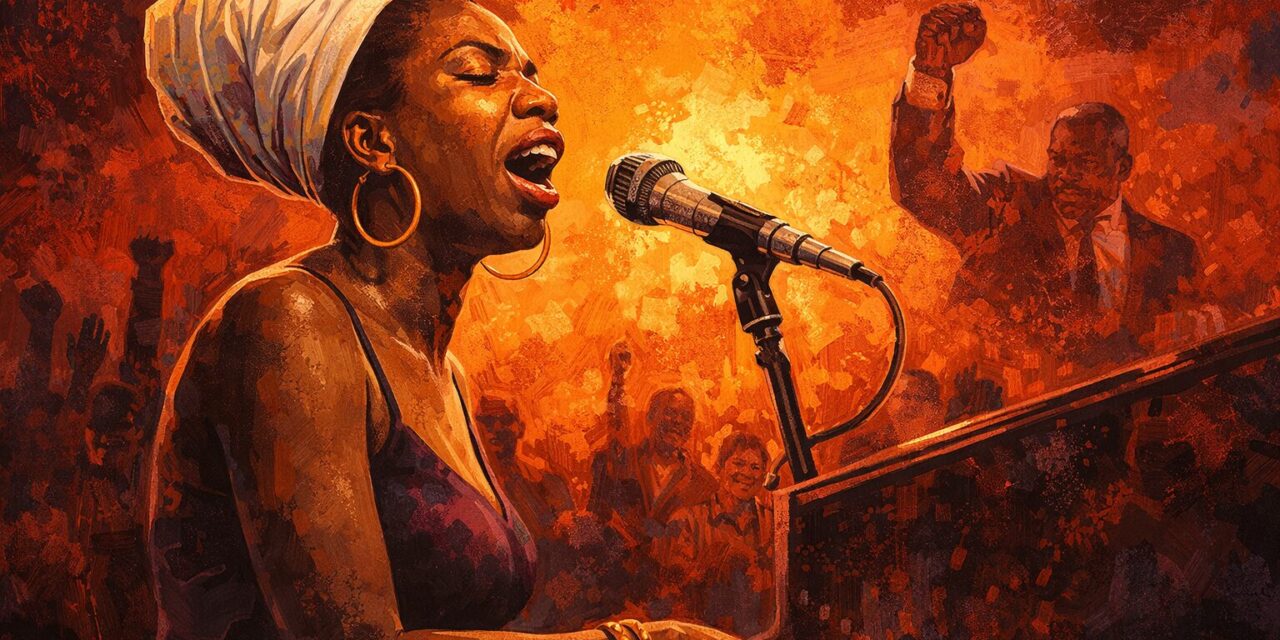
There are artists who perform. And then there are artists who command.
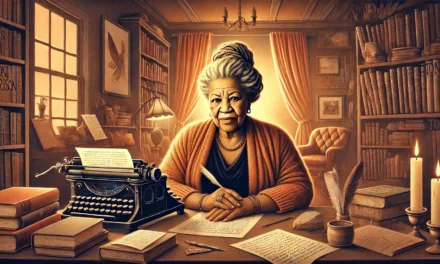
Nina Simone did not ask for attention. She seized it. Born Eunice Kathleen Waymon in Tryon, North Carolina, on February 21, 1933, she was a prodigy at the piano before she was a teenager. Trained in classical music and deeply influenced by Bach, she dreamed of becoming the first Black classical concert pianist in America.
When the Curtis Institute of Music denied her admission in 1951, a rejection she believed was racially motivated, something in her shifted. If the gatekeepers would not open their halls to her, she would build her own stage. And once she did, no one controlled it but her.
A Voice That Refused Permission
Simone blended classical structure, jazz improvisation, blues feeling, and gospel fire into something that could not be categorized neatly. Songs like “I Loves You, Porgy,” “Mississippi Goddam,” and “To Be Young, Gifted and Black” were not merely performances. They were declarations.
On stage, she was magnetic and severe. She did not smile for comfort. She did not soften her words to soothe fragile listeners. When she sat at the piano, the room belonged to her. Men who owned clubs, men who ran record labels, men who controlled radio programming all learned the same lesson. She would not bend.
She often clashed with executives who wanted lighter material, safer lyrics, more “commercial” direction. Simone answered by writing protest anthems in the wake of the 1963 Birmingham church bombing. “Mississippi Goddam” was blistering, unapologetic, and direct. Radio stations banned it. She performed it anyway.
That is domination of another kind. Not physical force, but moral force. The refusal to dilute truth for comfort.
Political Power in Heels and a Head Wrap
Simone was deeply involved in the Civil Rights Movement. She was close to figures like Malcolm X, Martin Luther King Jr., and Lorraine Hansberry. Yet she was never anyone’s accessory. She did not orbit male leaders. She stood alongside them, and often apart from them.
Where King preached nonviolence in measured cadence, Simone’s piano thundered with fury. Where Malcolm X spoke of liberation, she translated that urgency into melody that made audiences shift in their seats.
Her power unsettled people. Especially men who were accustomed to women entertainers being pleasant, pliable, grateful. Simone could be sharp in interviews, direct to the point of discomfort. She challenged journalists, corrected assumptions, demanded respect.
If a crowd was too loud, she stopped playing. If she felt disrespected, she would scold the audience like schoolchildren. And they listened.
Control Over Her Art and Her Identity
Simone’s insistence on autonomy came at a cost. She battled record contracts that exploited her. She struggled financially at times because she refused to surrender ownership and creative control. Her marriages were complicated and, in some cases, abusive. Yet even in those turbulent personal chapters, her artistic will remained unmistakable.
She left the United States for periods of self imposed exile, living in Liberia, Switzerland, France, and the Netherlands. It was not escape. It was choice. She refused to be contained by a country that would celebrate her voice while resisting her message.
Her later performances carried the weight of a woman who had seen too much, felt too deeply, and refused to apologize for either. When she sang “Feeling Good,” it was not a lighthearted tune. It was reclamation.
Dominating History
Nina Simone dominated history not because she was easy to love, but because she was impossible to ignore.
She expanded the definition of what a Black woman artist could be. Not decorative. Not background. Not compliant. She merged art and activism in ways that paved the path for generations of performers who refuse to separate stage from struggle.
Artists from Lauryn Hill to Alicia Keys, from classical pianists to political rappers, stand in the space she carved open with her own hands.
When she sat at the piano, men did not shape her career. They reacted to it. They negotiated around it. They attempted to manage it. But she dictated the tone, the tempo, the truth.
And history, whether it liked it or not, adjusted itself to her key.



































A powerful woman, and her songs are still so relevant.