
























Rosalind Franklin and the Power of Proof
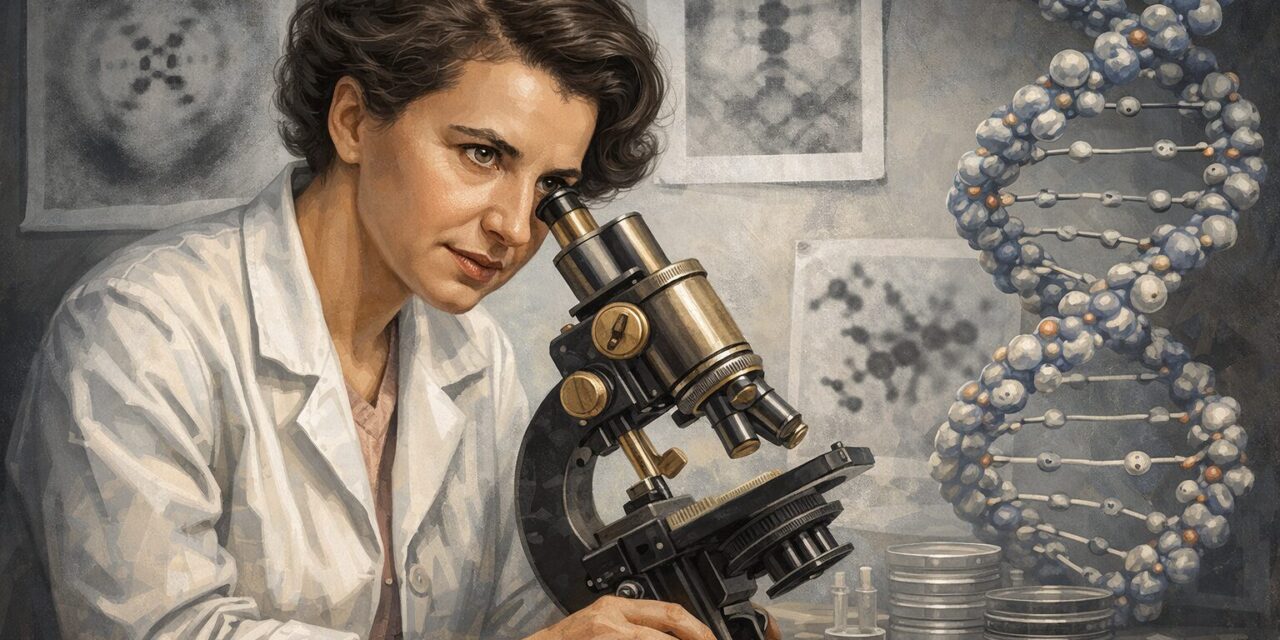
There are some women who dominate through volume. Others through charm. And then there was Rosalind Franklin, who ruled with something far more devastating to fragile egos and uncertain men: proof.
Rosalind Franklin was born on February 25, 1920, in London, into a well-educated Jewish family that valued intellect and service. From the beginning, she possessed a mind that did not bend easily. She studied chemistry at Cambridge and developed an extraordinary mastery of X-ray diffraction, a technique that would allow her to see what others only theorized about.
When she joined King’s College London in 1951, DNA was still a mystery wrapped in speculation. Men debated its structure. They postured. They theorized.
Franklin measured.
With ruthless precision, she produced what would become known as Photograph 51, the clearest X-ray diffraction image of DNA ever taken at the time. It revealed the unmistakable signature of a double helix. It was not guesswork. It was not intuition. It was data so clean and disciplined that it left no room for argument.
Without her consent, that image was shown to James Watson and Francis Crick, who used it to refine their model of DNA’s structure. In 1953, they published the famous double-helix model in Nature, alongside papers from Franklin and her colleague Maurice Wilkins.
In 1962, Watson, Crick, and Wilkins received the Nobel Prize. Franklin had died four years earlier from ovarian cancer at the age of 37. The Nobel is not awarded posthumously. Her name was largely absent from the public celebration.
But here is what men often misunderstand about domination.
It does not always require applause.
Franklin’s authority was not social. It was structural. Her data underpinned modern genetics, molecular biology, forensic science, biotechnology, and medicine. Every time DNA is sequenced, every time a genetic disease is traced, every time paternity is established or a genome edited, her work echoes beneath it.
She did not flirt with error. She did not soften conclusions for male colleagues who resented her clarity. She demanded rigorous standards. She corrected assumptions. She expected competence. Those who found her “difficult” were often simply unprepared for a woman who would not defer.
Even after leaving King’s College, she led groundbreaking research on viruses at Birkbeck College, contributing foundational work on the tobacco mosaic virus and laying groundwork for structural virology.
She dominated not through spectacle, but through discipline.
Her legacy has only grown stronger with time. As historians revisited the discovery of DNA’s structure, it became undeniable: without Franklin’s diffraction images and mathematical analysis, the double helix would not have been solved when it was.
Truth, when properly measured, has a way of commanding history.
And Rosalind Franklin measured it better than anyone else in the room.













These all poses are really good for a slave. This tells him his position in front of a female, wife,…
My mistress wife saw this article and she is really expert in this domain. Can she post her experience?
A very realistic article by madam. My mistress wife is very good in such type of plays
Thank you Mistress Heather for You article, “ EROTIC FEAR AND THE APPEAL OF CONSENSUAL SUSPENSE”. My kink has always…
What better way and time of year to get into chastity - literally! Hope the joruney goes well and who…