























How to Train Him as Your Familiar for Halloween
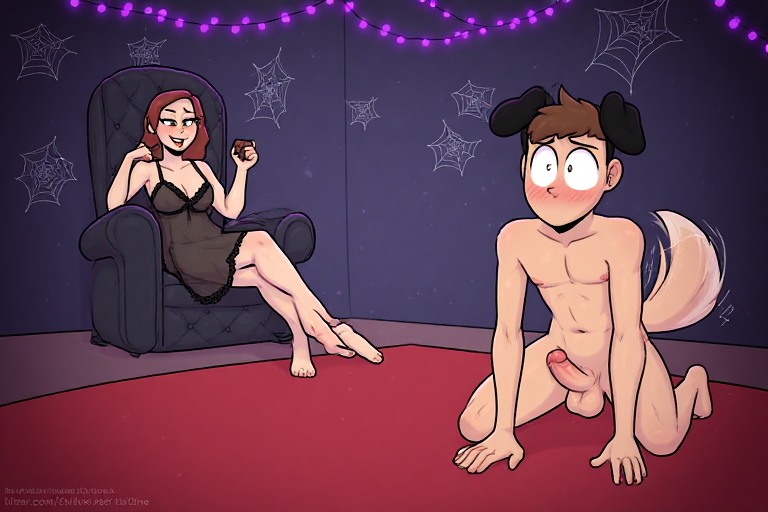
A familiar is an animal companion associated with a witch, and familiar roleplay is a consensual activity in which an adult adopts an animal identity through behavior, signals, and ritual. For Halloween, I prefer that second definition to involve considerably more household usefulness than a plastic cat perched beside a cauldron. Give me an attentive familiar who comes when called, settles where directed, and remembers where I left my book. Ears are optional. Attention is compulsory.
I love Halloween because it gives ordinary household routines a deliciously strange atmosphere. A chair becomes the witch’s seat. A cushion becomes the familiar’s station. A small bell acquires a significance it certainly did not possess when it came out of the kitchen drawer. You do not need an elaborate costume to make this work. You need a clear identity, a few consistent rules, and the patience to teach them.
The mistake beginners make is dressing him as an animal and expecting the clothing to do the training. It will not. A man wearing ears can still interrupt, wander away, and ask fourteen questions about what happens next. Build the behavior first. Add the ears when he has earned the right to look convincing.
Choose a Familiar You Actually Want to Live With
Start by choosing an animal identity that suits both his interests and your household. A cat might practice quiet proximity, measured movement, and settling beside your chair. A dog might focus on recall, retrieving designated objects, and waiting attentively for instructions. A raven might collect approved objects for your Halloween table and deliver written messages. An owl might serve as a still, watchful companion who notices when something needs your attention.
These are imaginative roles, not tests of whether he can reproduce an animal perfectly. Your raven does not need to hop across the living room with a spoon in his mouth. He can walk upright, carry the spoon in his hand, and place it precisely where instructed. The identity comes from the pattern of behavior you establish.
Ask what appeals to him about the role. Does he enjoy having fewer decisions to make? Does quiet companionship suit him? Would he rather perform small errands than remain still? His answers help you select a role that can sustain an evening instead of collapsing after ten minutes of uncomfortable crawling.
I would much rather have a convincing seated owl than a miserable wolf with aching wrists. Choose intelligently.
Agree on the Rules Before Lighting the Candles
Discuss the session while both of you are speaking normally. Agree on its duration, the movements involved, whether touch is welcome, and which costume elements he wants to wear. Establish whether the role remains private or includes guests who have agreed to participate. Nobody should discover that they have become an audience member halfway through their visit.
Nonverbal play needs an especially clear way to pause. Give him a spoken stop word that remains available throughout the activity, along with an easy gesture such as raising an open hand. Ordinary speech must always be permitted for discomfort, practical questions, or anything important.
My rule would be simple: quiet is part of the role, but communication outranks the role. If he needs to tell me something, he tells me. A familiar who conceals a problem to preserve the atmosphere has misunderstood the assignment.
Keep the first session brief enough that you can finish while both of you still enjoy it. Twenty or thirty minutes gives you plenty of time to teach a few behaviors and discover what needs adjusting.
Give Him a Place in Your Household
A designated station makes the identity tangible. Choose a cushion, a sturdy chair, a folded blanket, or a clear space beside your own seat. It should be comfortable, accessible, and positioned where he can hear you without straining.
Name it. “Your perch” suits an owl or raven. “Your place” works beautifully for a dog. A cat might have a particular cushion beside the witch’s chair. The name matters less than using it consistently.
Teach the station before adding other tasks. Say the cue, indicate the location, and have him settle there in the agreed posture. Acknowledge success, then release him with another clear cue. Repeat a few times until he understands both arriving and leaving.
Do not confuse a station with confinement. He needs to be able to change position, use the bathroom, and leave the activity. The pleasure of a designated place comes from knowing where he belongs during the game.
Teach Posture Before Movement
Choose one resting posture and one attentive posture. Resting might mean sitting comfortably on the cushion with relaxed hands. Attentive might mean sitting upright, turning toward you, and waiting for the next instruction. Those two positions are enough to create a visible difference between settling and responding.
Demonstrate what you want instead of issuing vague commands. “Sit comfortably and turn toward me when you hear your name” is useful. “Look more like my familiar” leaves him guessing.
If you include floor movement, keep it optional and brief. Clear the route and avoid slippery surfaces, stairs, furniture obstacles, or positions that cause discomfort. Upright movement remains entirely compatible with the role. A familiar can be wonderfully convincing while walking on two feet.
For Halloween atmosphere, slow the movement slightly. Have him approach, stop at a designated point, and wait to be acknowledged. That little pause can establish more presence than an entire bag of costume accessories.
Build a Small Nonverbal Vocabulary
Select three or four signals and practice them openly. An open palm might mean wait. A gesture toward the station might mean settle. Two fingers extended toward you might mean approach. A nod can acknowledge that he has understood.
Use one signal for one meaning. If the same hand movement sometimes means come closer and sometimes means retrieve a book, you have created confusion, not mystery.
Give him a response that suits his identity without requiring a performance he dislikes. Your owl might incline his head. Your cat might turn his attention toward you. Your dog might sit attentively. Animal noises are optional, and silence can be far more atmospheric than enthusiastic barking.
During training, pair the gesture with a spoken instruction. Once he understands it, try the gesture alone. If he gets it wrong, return to the clear instruction and repeat. Teach the behavior you want him to remember.
Make His Service Fit the Identity
A familiar should have a small, recognizable job. Choose safe tasks that he can perform reliably and that contribute to the evening.
For a raven, place three approved objects on a tray and ask him to bring the one you name. For a dog, practice retrieving a soft prop or carrying a folded blanket to your chair. For an owl, assign the role of quiet attendant who brings your notebook when summoned. For a cat, make companionship the central task, with an occasional invitation to approach and sit nearby.
Teach each task in stages. First identify the object. Then identify its destination. Finally add the cue that begins the task and the cue that ends it. Demonstrate once, let him try, and acknowledge the part he gets right.
Keep hot drinks, flames, sharp objects, and awkward loads out of movement games. Carry objects in hands. You are creating a household ritual, and there is no need to make an ordinary errand unnecessarily difficult.
My favorite test would be wonderfully mundane: can he bring the correct book, place it within reach, and return to his station without launching into a conversation? That tells me considerably more about his attention than whether his tail matches his ears.
Turn Refreshments Into a Ritual
A feeding ritual can simply mean serving an ordinary snack at an appointed time, in a designated place, with a clear invitation to begin. The ritual lies in the sequence and presentation.
Ask about preferences and allergies beforehand. Use normal food, suitable dishes, and a comfortable eating position. Water remains available whenever he wants it, and regular meals are not something he needs to earn through performance.
For a raven, you might prepare a small plate of fruit and crackers beside his station. For a cat, perhaps a favorite warm drink after the training ends. For a dog, a snack can mark the completion of a retrieving exercise. Nobody needs to eat from the floor to make the scene convincing.
I like the moment of acknowledgment: “You have completed your duties. Come and have something to eat.” It gives the evening a rhythm and lets him feel the transition from concentration to rest.
Add One Costume Element With a Purpose
Once the behavior is established, choose a simple visual cue. Ears, a feathered brooch, a dark vest, face paint, or a ribbon attached to clothing can suggest the identity without overwhelming it.
Check that the item is comfortable and does not restrict breathing, sight, hearing, or movement. Avoid anything that pulls against the neck or can snag during a task. If an accessory becomes distracting, remove it and continue.
You can make receiving the accessory part of the opening ritual. Ask him to take his station, review the signals, and then present the item: “Tonight, this marks your role as my raven.” That gives a modest prop meaning through context.
A costume should help him enter the role. It should not become the most demanding part of the evening.
Run a Short Halloween Rehearsal
For the first complete session, prepare the room with subdued lighting that still allows safe movement, a little atmospheric music, and one visual centerpiece. A decorative lantern or a closed book on your table is enough. Keep walkways clear and use flameless candles wherever movement occurs.
Begin by naming his role and reminding him of the pause signal. Send him to his station, call him to approach, and give him one familiar task. Let him complete it and settle again. Repeat with a second task only if the first goes smoothly.
Then allow a few minutes of quiet companionship. Read, write, or listen to the music while he remains nearby in a comfortable position. This is where behavioral immersion often becomes convincing. He no longer needs constant instructions because he understands the pattern.
Finish with refreshments and a clear release cue. Tell him the role has ended, invite ordinary conversation, and ask which parts felt natural or awkward. Use his answers to plan the next session.
Correct the Training Without Breaking the Trust
Mistakes tell you what needs more teaching. If he retrieves the wrong item, narrow the choice. If he misses a signal, make it clearer. If he cannot remain comfortable at his station, change the station.
Do not turn an unclear instruction into a character flaw. A beginner who has never practiced silent signals cannot reasonably be expected to interpret every movement of your hand.
You can remain firm and enjoy the authority of the role while being precise. “Return to your perch. We will try that again” is a complete correction. Follow it with a clear opportunity to succeed.
A practiced familiar will eventually respond to small cues with very little fuss. That is earned through repetition, not through expecting him to read your mind on Halloween night.
Let the Familiar Follow You Home
The best Halloween familiar is the one whose role has become recognizable through attention, movement, and small acts of service. Build a comfortable station, teach a handful of clear cues, and give him tasks that belong to the creature you have chosen together. Then let the atmosphere do its work. By the time you pick up your book and he quietly brings the blanket, those inexpensive ears will have acquired considerably more meaning.
FAQ
What is familiar roleplay?
Familiar roleplay is a consensual adult activity inspired by the animal companions associated with witches. Participants create an animal identity through agreed behaviors, signals, designated spaces, and simple rituals.
Does he need to crawl or make animal sounds?
No. Upright movement, attentive posture, quiet companionship, and suitable service tasks can establish the role. Crawling and animal sounds are optional.
How do we communicate during nonverbal play?
Agree on a small set of clear signals and practice them before beginning. Keep a spoken stop word and an easy pause gesture available, and allow ordinary speech whenever something important needs communicating.
What tasks suit a Halloween familiar?
Suitable tasks include retrieving approved props, carrying a folded blanket, delivering written messages, bringing a book, or settling nearby as a quiet companion. Match the task to his abilities and the chosen identity.
Can refreshments be part of the role?
Yes. An ordinary snack served at a designated time can become a ritual. Use suitable food and dishes, maintain a comfortable eating position, and keep water freely available.
How should the session end?
Use an agreed release cue, remove costume elements if desired, and return to ordinary conversation. Discuss what felt enjoyable, comfortable, or confusing before planning another session.
















Hello Mistress Heather, my name is Scott and I am a fireman in NC. I would like to know if…
I’ve found that when my dome is dressed casually, maybe just snug jeans, or yoga pants and a tee shirt…
Pute, your imagination can build an entire boulevard of silk, perfume, and beautiful women, then bring you right back to…
Thank You Mistress! As far as the pink cage goes, I will let You and Mizz Geena make that decision.…
Good boy mayi. Short and sweet. I think keeping you in the pink cage should be your norm, but Mizz…