
























Valentina Tereshkova is The Woman Who Rose Above the Boys’ Club
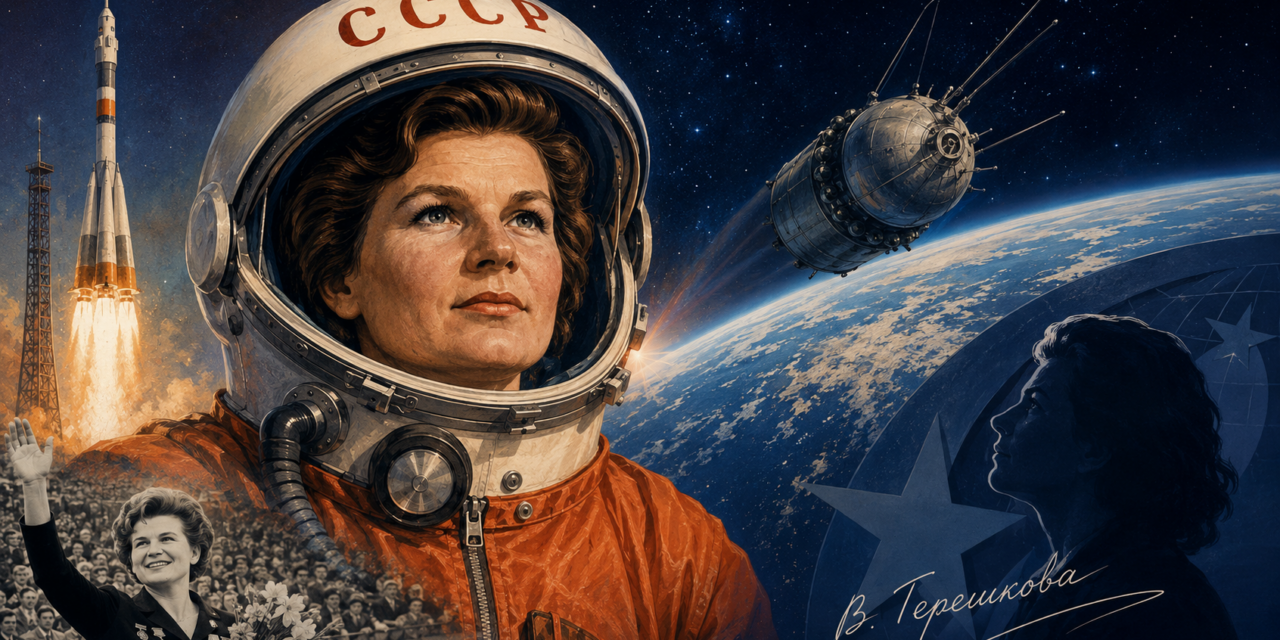
There are moments in history when a woman does not simply enter a male-dominated world. She changes the very definition of who is allowed to belong there. Valentina Tereshkova’s journey into space is one of those moments, a turning point that permanently altered humanity’s understanding of who an explorer could be.
On June 16, 1963, Tereshkova was strapped alone inside the Vostok 6 spacecraft and launched from the Baikonur Cosmodrome. At just 26 years old, the former textile worker and amateur parachutist became the first woman in history to travel into space. Over the course of nearly three days, she orbited Earth 48 times, conducted scientific observations and experiments, kept detailed flight logs, communicated with mission control by radio, and ultimately returned safely to Earth.
Her achievement cannot be separated from the political climate of the Cold War. The Soviet Union was locked in a fierce competition with the United States, and each space milestone carried enormous symbolic weight. Sending a woman into orbit was not only a scientific decision but also a political statement designed to showcase Soviet claims of gender equality. Even NASA’s historical records acknowledge that propaganda played a role in the selection of a female cosmonaut.
Yet political motivation does not diminish the reality of what Tereshkova accomplished. Men had already been to space. Men controlled the space agencies, the military structures, and the scientific institutions that defined early space exploration. In that context, Tereshkova’s solo flight was not just symbolic—it was a direct challenge to the assumption that space belonged to men.
From a modern perspective, there is something striking about that image. A young woman, alone in a spacecraft, orbiting a planet whose space programs were entirely controlled by men, quietly proving that she belonged there as much as anyone else. It took only a little more than two years after Yuri Gagarin’s historic flight for that assumption to be rewritten.
From the Textile Mill to the Sky
Valentina Tereshkova was born on March 6, 1937, in the Yaroslavl region of the Soviet Union. Her early life gave no obvious indication that she would one day become one of the most famous women of the Space Age. Her father worked as a tractor driver, and her mother was employed in a textile factory. Like many working-class children of her time, Tereshkova left formal schooling early and entered industrial work, continuing her education through correspondence courses.
The skill that ultimately changed her life was parachuting.
She joined a local flying club and made her first parachute jump in May 1959 at the age of 22. From that point on, she developed significant experience as an amateur parachutist while continuing her factory work. This unusual combination of physical courage, technical discipline, and working-class background would later make her an ideal candidate when Soviet authorities began searching for women to train as cosmonauts.
Parachuting was not a casual hobby in this context—it was directly relevant to spaceflight. The Vostok program required cosmonauts to eject from their capsules during descent and complete their return to Earth by parachute. Tereshkova’s experience meant she already possessed a skill essential to surviving a mission.
Long before she was selected, she had already been practicing the final stage of spaceflight on Earth.
Competing for a Place Among the Cosmonauts
After Yuri Gagarin became the first human in space in April 1961, the Soviet space program expanded its ambitions to include women. More than 400 candidates were considered, and in February 1962, five women were selected for cosmonaut training. Tereshkova was among them.
Their training was intense and comprehensive. It included isolation tests, centrifuge training to simulate extreme gravitational forces, weightlessness flights, jet aircraft instruction, and extensive parachute practice. According to ESA records, the women completed around 120 parachute jumps as part of their preparation.
However, the selection process was not purely technical. Soviet officials were not only choosing a capable astronaut—they were choosing a public symbol. The woman selected would represent the Soviet Union on the world stage, embodying its political ideals as much as its scientific ambitions.
NASA historical accounts note that Tereshkova’s selection reflected both her qualifications and her perceived political reliability. Her main competitor, Valentina Ponomaryova, was considered highly skilled but was viewed by some officials as less suitable for the carefully constructed image of Soviet femininity.
This context adds complexity to Tereshkova’s story. She was undeniably a pioneer, but she was also part of a system in which powerful men shaped the meaning of her achievement before it ever occurred. The Soviet leadership wanted a symbol. What they received was something far more enduring: proof that a woman could survive and succeed in space.
The Seagull Takes Flight
Tereshkova’s call sign was “Chaika,” meaning “Seagull.”
On June 16, 1963, Vostok 6 launched into orbit with Tereshkova aboard. She was 26 years old. At the same time, another cosmonaut, Valery Bykovsky, was orbiting Earth in Vostok 5. During the mission, the two spacecraft came within close proximity of each other, allowing radio communication between them. Although they were not physically together, the coordination of their flights created a historic moment of dual human presence in space.
Tereshkova’s mission lasted approximately 70.8 hours—just under three days. During that time, she completed 48 orbits of Earth. She conducted physiological experiments, observed Earth’s atmosphere, and photographed the planet below. Some of her images later contributed to scientific understanding of atmospheric layers.
One of the most remarkable aspects of her mission is the amount of time she spent in space compared to her contemporaries. At that point in history, she had accumulated more time in orbit than all American Mercury astronauts combined.
One woman. One mission. More time in space than an entire national program had achieved up to that moment.
More Than a Passenger
It is easy to summarize Tereshkova’s legacy with the phrase “first woman in space,” but that description understates the difficulty of what she endured. Early spaceflight was not routine travel—it was experimental, dangerous, and physically punishing. The technology was still in its infancy, and every mission carried significant risk.
Tereshkova also flew alone. Vostok 6 carried only one human being. There was no crew, no co-pilot, and no companion inside the spacecraft. Once in orbit, she was entirely on her own.
That isolation matters. She was not part of a team inside the capsule. She was the team.
She endured the intense forces of launch, the psychological strain of prolonged confinement, and the physical demands of operating in a primitive spacecraft. After nearly three days in orbit, she successfully returned to Earth on June 19, descending by parachute as required by the Vostok design.
The mission had been intended as a demonstration. It succeeded beyond expectations.
The Woman Became Bigger Than the Propaganda
Following her flight, Tereshkova became an international figure. She was awarded the title Hero of the Soviet Union and traveled widely as a representative of her country. She later studied at the Zhukovsky Air Force Academy, graduating in 1969, and went on to have a long career in public service and politics.
Her later life reflects the complexity of her position. She was deeply connected to the Soviet political system and did not present herself as a Western-style feminist icon. Her role was shaped by the state, and she remained within that framework throughout her career.
However, none of this diminishes the significance of her achievement.
What is perhaps most revealing is what did not happen afterward. Tereshkova did not return to space. More strikingly, no other woman flew in space for nearly two decades. It was not until 1982 that Soviet cosmonaut Svetlana Savitskaya followed her. The United States did not send a woman into space until Sally Ride’s flight in 1983.
The message had been delivered in 1963. The institutions of space exploration simply took a long time to fully acknowledge it.
She Changed What an Explorer Looked Like
Before Tereshkova’s flight, every human who had traveled into space was male. The image of the astronaut was firmly tied to military pilots, engineers, and male national heroes. Space exploration was culturally coded as masculine.
Tereshkova disrupted that image permanently.
She proved that a woman could endure training, survive launch, function in orbit, and return safely to Earth. She demonstrated that spaceflight was not inherently male.
These truths should never have required proof, but in the early 1960s, they did. Tereshkova provided that proof in the most visible way possible.
Her flight did not immediately create equality in space exploration, but it made exclusion harder to justify. Once a woman had been to space, the argument that women could not go became impossible to sustain.
How Valentina Tereshkova Dominated History
Tereshkova’s place in history carries a literal and symbolic weight. She did not simply challenge male dominance in theory—she physically rose above it, orbiting the Earth while the institutions below remained overwhelmingly male.
But her true impact was not altitude. It was possibility.
She expanded the boundaries of what humanity believed an explorer could be. Whatever the Soviet Union intended, the result was irreversible: a woman had entered space, completed a mission, and returned successfully.
From that moment forward, every woman who followed her into space did so in a world that had already been changed by her flight.
Valentina Tereshkova was not the first human in space. She was something different and arguably more transformative.
She ensured that space would never again be considered exclusively male territory.
And as Levi, a man who spends a great deal of time documenting women who quietly dismantle male assumptions, I find her story especially striking. Some women dominate rooms. Some dominate fields. Valentina Tereshkova did something rarer.
She looked at the most exclusive frontier of her era and dominated it from orbit.


















Funny, this post. Seems often our minds move in similar directions. Discussing of we’re to have a Halloween party, or…
This is SOP here in my group.: 9 Dommes, 7 toys; one of each still very much learning. Because of…
The "Good Elf" affirmations thing is actually cute, but leaving notes in the bathroom feels like a lot of effort…
Good analysis on worthwhile topic. I would like to hear your thoughts on some extensions of these circumstances: Multiple female…
I like the “Good Elf” affirmations twist—makes the usual praise feel seasonal. Though I’d skip the hints and just go…