























Jane Goodall – The Primatologist Who Forced Science to Listen
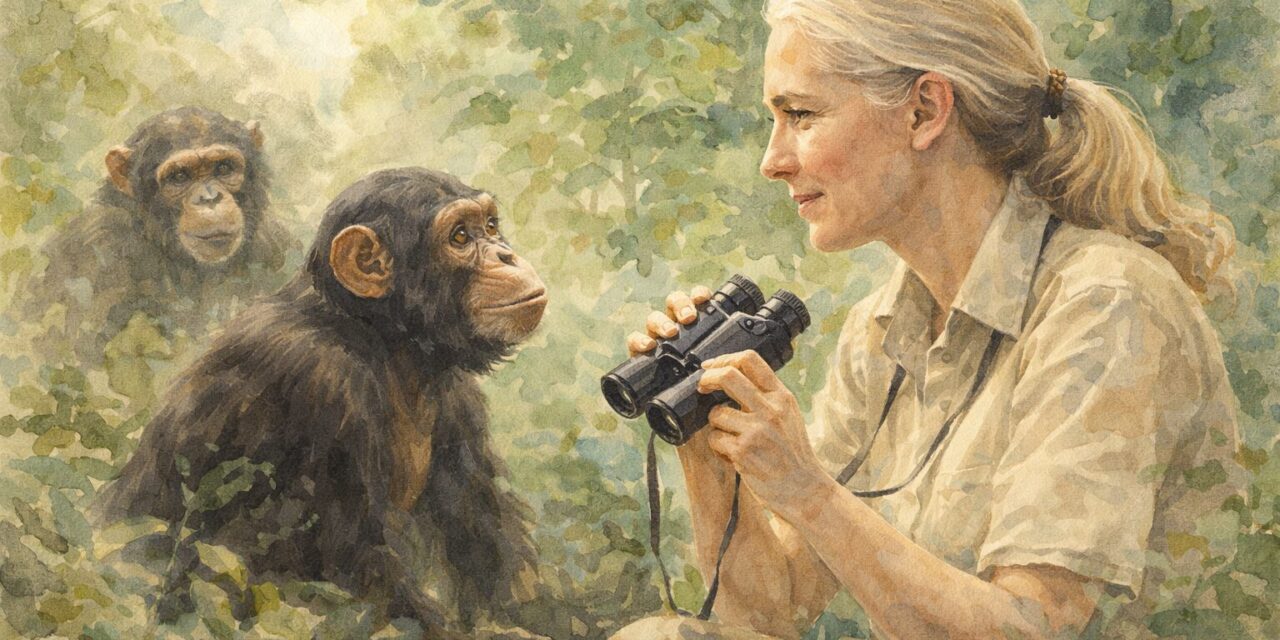
On March 14, 1960, a young Englishwoman stepped onto the shores of Lake Tanganyika and began research that would permanently alter the course of science. She had no formal degree. No institutional authority. No chorus of male academics welcoming her into their ranks.
Her name was Jane Goodall.
And from the forests of Gombe Stream National Park, she reshaped humanity’s understanding of itself.
A Different Kind of Power
When Goodall began her research at Gombe, primatology was dominated by men who valued distance, detachment, and hierarchy. Animals were specimens. Data was sterile. Emotion was suspect.
She did something revolutionary.
She watched.
She waited.
She listened.
Rather than imposing control, she earned trust. Rather than conquering nature, she allowed it to reveal itself. It was a softer posture, but infinitely stronger.
The Discovery That Shook Science
One of her earliest observations would detonate a scientific assumption that had stood for generations. She witnessed chimpanzees stripping leaves from twigs and using them to extract termites from mounds.
Tool use.
At the time, humanity defined itself as the only toolmaking species. Her findings forced the academic world to confront a humiliating possibility. They had been wrong.
Her mentor, Louis Leakey, recognized the magnitude of the discovery immediately. Science would have to redefine tool, redefine man, or accept that chimpanzees shared what had once been considered uniquely human.
A young woman without credentials had compelled that reckoning.
Naming Instead of Numbering
Goodall gave chimpanzees names instead of numbers. David Greybeard. Flo. Fifi.
Male colleagues criticized her for it. They claimed she was projecting emotion. They warned she was compromising objectivity.
But she was not projecting. She was observing.
She documented affection between mothers and infants. Political alliances among males. Violence. Grief. Strategy. Tenderness.
She revealed that chimpanzee societies possessed social structures and emotional depth that mirrored our own.
Her critics faded.
Her data endured.
Authority Earned in the Field
Eventually, Goodall earned her doctorate from University of Cambridge, one of the few students admitted without first holding an undergraduate degree.
But by then, she had already proven her authority.
She did not wait for permission to be taken seriously. She did not soften her findings to comfort established men. She allowed the truth to stand, even when it unsettled entire departments.
Her dominance was not theatrical. It was disciplined. Relentless. Patient.
From Researcher to Global Leader
In 1977, she founded the Jane Goodall Institute, expanding her influence beyond academia into global conservation, environmental education, and youth leadership through the Roots and Shoots program.
She became a moral force in environmental advocacy. Governments listened. Universities taught her methods. Young scientists, many of them women, followed her model of immersive, compassionate fieldwork.
She did not simply contribute to primatology.
She transformed it.
How She Dominated History
Jane Goodall overturned male-dominated science not by force, but by conviction.
She forced experts to confront flawed definitions of humanity.
She legitimized empathy within scientific observation.
She proved that authority can be earned through presence rather than position.
She sat in the forest until the world had no choice but to listen.
And in doing so, she redefined both science and strength.
























Her achievements are nothing short of legendary. The world was lessened when she passed last year.