
























Homer’s Odyssey: A Masterclass in Female Dominance
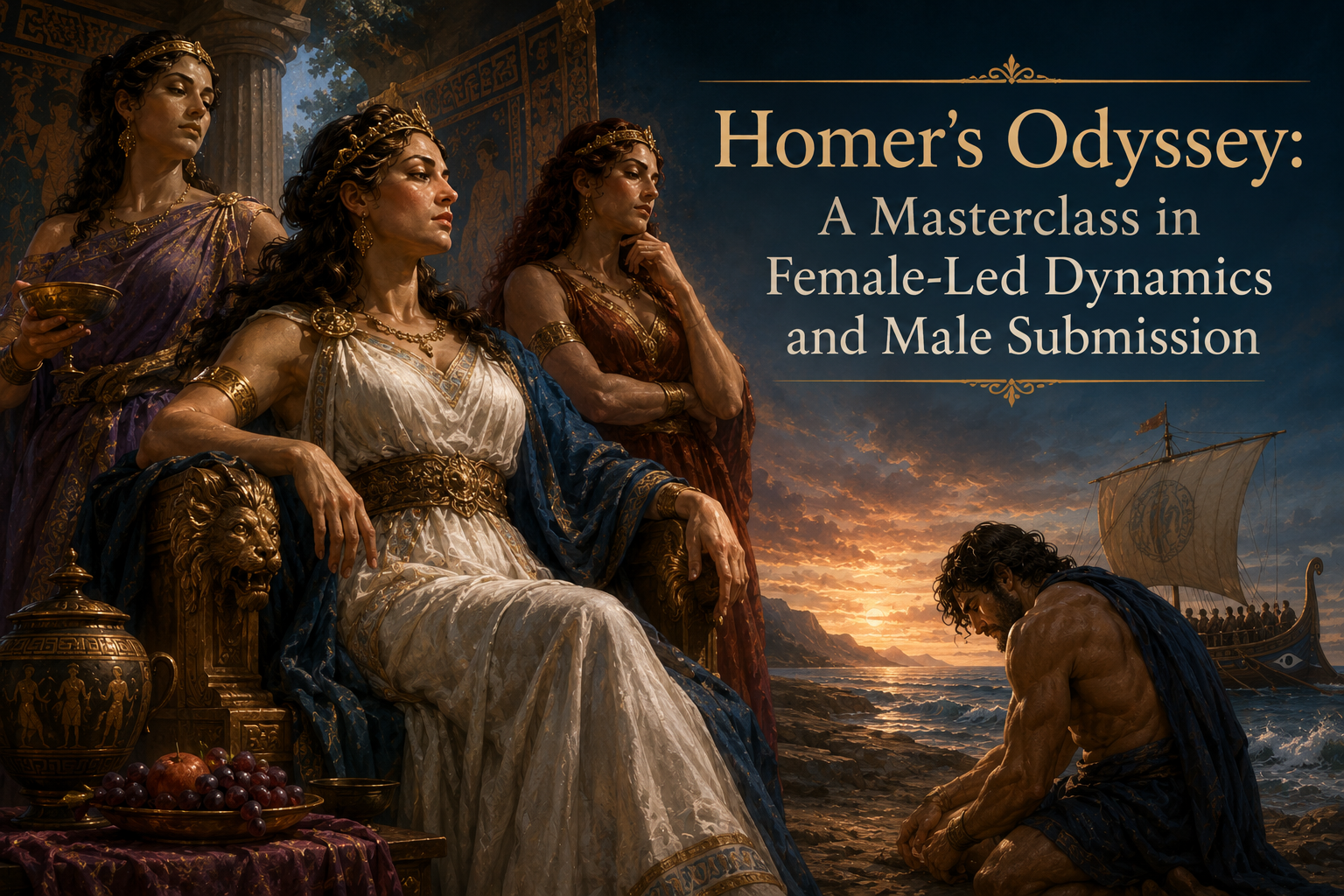
Sex, Strategy, and Female Control in Classical Myth
On the surface, Christopher Nolan’s blockbuster adaptation of The Odyssey delivers classic Hollywood spectacle: Matt Damon as a war-torn Odysseus, Zendaya as Athena, and Anne Hathaway as Penelope. But look past the armor and battle cries, and a sharper truth emerges: Homer’s ancient epic is a masterclass in Female-Led Dynamics and male submission.
The Odyssey isn’t a story about male heroism. Beneath the decade of shipwrecks and monsters Odysseus endures after the Trojan War, on his journey back to Ithaca, lies a tale of total female control. Across twenty-four chapters (2 hours 52 minutes for the movie), Odysseus is controlled by a succession of dominant women who hold his fate in their hands. From Goddesses to Queens and Nymphs, true authority belongs to the powerful female archetypes orchestrating every step of his journey.
Athena: The Divine Domme of Control
While male gods like Poseidon throw reckless fits of rage, Athena rules with cool, absolute authority. As the supreme strategist and goddess of divine warfare, her brilliance won the Trojan War – and her relentless oversight dictates Odysseus’s every move.
Athena manages his ego, directs his decisions, and demands total obedience before allowing him to succeed. When he washes ashore in Phaeacia broken and humbled, she takes full charge of her subject, concealing his weakness and orchestrating his survival. She routinely adopts male disguises to enforce her commands without question. Men may carry the weapons in Athena’s world, but her psychological dominance dictates the outcome.
Calypso and Circe: The Temptress Captrix and Sorceress Domme
Odysseus’s most profound trials occur in the realms of two supreme Dominants: Calypso and Circe, whose beauty and authority bring the Greek hero to his knees.
On her island of Ogygia, Calypso keeps Odysseus as her submissive lover for seven years. Offering him immortality only in exchange for absolute devotion, she reduces the famed warrior to weeping hopelessly on her shoreline. Force and negotiation are useless in her domain; he remains hostage for sex until a higher authority commands his release. In Nolan’s adaptation, Calypso simply releases Odysseus out of genuine care and self-assurance.
Where Calypso uses isolation to control him, Circe exercises absolute command over the male ego. She begins by turning his crew into pigs with her enchanted potion. When Odysseus attempts to resist, she forces him to yield his pride and surrender to her. To survive, he must learn submissive discipline, yielding to her supremacy to earn her guidance. Hollywood gets this wrong. In a departure from Homer’s original poem, it is Odysseus’ impassioned speech, not sex, that gets Circe to reverse course.
The Sirens: The Vocal Hypnotists
The Sirens show how helpless male strength is against female attraction. Without using physical violence, they command full control through a hypnotic voice that promises irresistible pleasure.
Knowing his willpower is useless against their song, Odysseus orders his crew to plug their ears and lash him tightly to the ship’s mast. Bound, immobilized, and utterly spellbound by their voices, the great Greek hero is reduced to total vulnerability and helpless bondage.
Penelope: Queen and Protector of Her household
While Odysseus wanders, Queen Penelope remains faithful and rules Ithaca, cunningly stalling her suitors.
By agreeing to remarry only after finishing a burial shroud, weaving by day and unraveling by night, she keeps 108 aggressive suitors waiting for three years. Without using a weapon, she bends an entire army of men to her timeline, making them submit to her terms. She holds political power in Ithaca through patience and mental dominance.
Even when Odysseus finally returns, Penelope refuses to surrender her domain. She acts as the ultimate gatekeeper, subjecting him to a final test, the secret of their immovable bed. She proves her consent is absolute, forcing the returning king to bow to her terms and earn her permission before reclaiming a place at her side.
The Enduring Truth
At its core, The Odyssey reveals a fundamental reality: male strength and ego are powerless without female strategy, governance, and consent. Sadly, Hollywood mostly focuses on blockbuster action and patriarchal violence. Yet in the true epic, Odysseus’s survival relies entirely on his willingness to submit to female authority, an enduring tribute to the inescapable power of female supremacy.
FAQ
Is The Odyssey really about female authority?
While traditionally viewed as the story of Odysseus’s journey home, many readers note that the most influential decisions throughout the epic are made by powerful women and goddesses who determine his survival and success.
Who are the most powerful women in The Odyssey?
Athena, Penelope, Circe, and Calypso each exercise different forms of authority, from strategic guidance and political control to magical dominance and emotional influence.
Did Homer intend The Odyssey to represent Female-Led Dynamics?
No historical evidence suggests Homer wrote the poem as an exploration of modern Female-Led Relationships. However, contemporary readers can identify themes of female authority, male dependence, and psychological control that resonate with those dynamics.
How accurate is Christopher Nolan’s adaptation?
Like most adaptations, Nolan’s film takes creative liberties. Some character motivations and relationships differ from Homer’s original text while preserving many of the epic’s central themes.
Why is Penelope considered so influential?
Rather than relying on physical force, Penelope protects her kingdom through intelligence, patience, and strategy, delaying more than a hundred suitors for years while maintaining control over Ithaca.
What makes Athena different from the other gods?
Athena represents wisdom, planning, and disciplined leadership. Instead of acting through anger or impulse, she carefully guides events, making her one of the epic’s most consistently effective figures.
















Did they have save words back then!! LOL!
Thank you for sharing this Pute. Reading about the strength, wisdom, and authority of women like Athena, Penelope, Circe, and Calypso was a great reminder of how true leadership shapes those who submit to it. As a submissive, I admire that kind of calm, unwavering authority and hope to continue learning to surrender more completely and serve with greater obedience and devotion.
Glad to see this! I’ve always felt exactly this way. The Odyssey IS about dominant women naturally and matter-of-factly (invented word) taking charge of one of literature’s most alpha males.
It happens.
I’ll boast for a moment: I did it too!! And it’s been real pleasure!!
Great piece! I was wondering if the movie was going to gloss over the themes of female leadership, and it sounds like that’s exactly what happened. I had a literature professor years ago who absolutely loved teaching *The Odyssey*, and one of the biggest takeaways was how much of the story is really driven by powerful women. Athena isn’t just helping Odysseus. She’s directing the game. Circe, Calypso, Nausicaa, Penelope… every one of them shapes his journey in some way.
Looking back, it’s funny how those lectures probably planted a few seeds in my head long before I understood why I found those dynamics so fascinating. Reading your article brought all of that back. Makes me want to go back and reread it with an even more Femdom-focused perspective.