























Chien-Shiung Wu and the Experiment That Forced Physics to Kneel
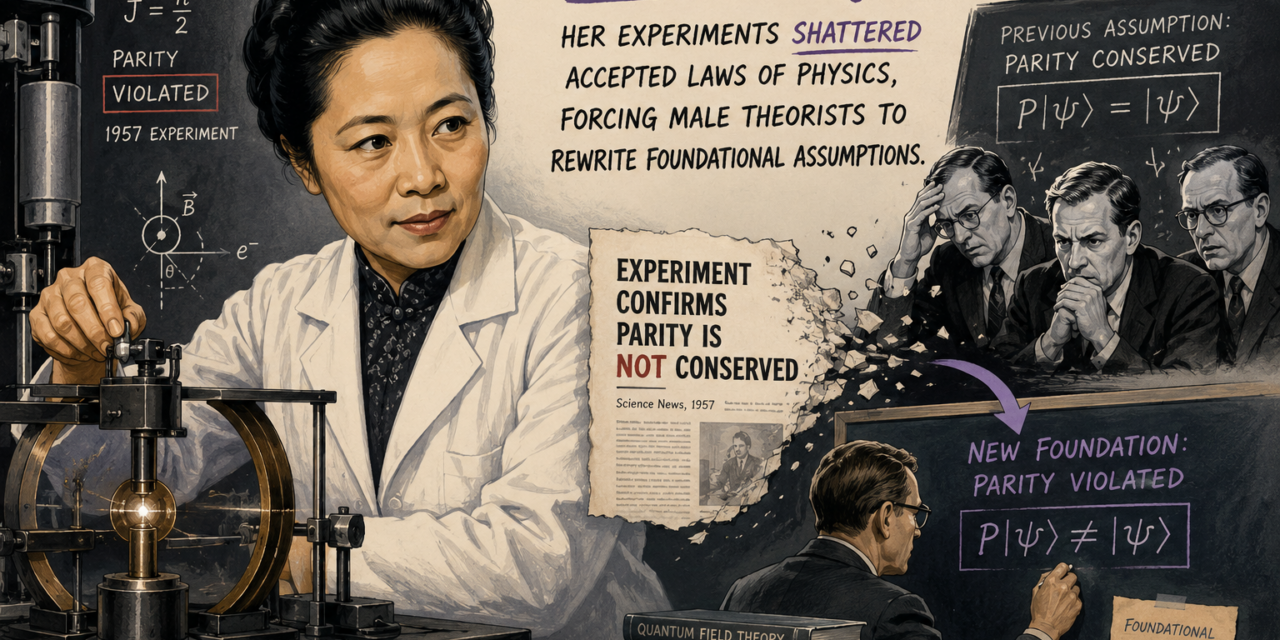
There are moments in scientific history when a discovery changes not just a field, but the confidence of the people inside it. Chien-Shiung Wu created one of those moments. With calm precision and extraordinary technical skill, she conducted an experiment so devastating to accepted theory that it forced physicists across the world to admit that one of their most sacred assumptions about nature was simply wrong.
For decades, physics had operated under the belief that the universe behaved symmetrically. The principle of parity conservation suggested that physical processes should function the same way if viewed in a mirror. It was elegant. Orderly. Comfortable. And almost entirely unquestioned by the male scientific establishment that dominated twentieth century physics.
Then Chien-Shiung Wu proved the universe did not care about their comfort.
Levi has always found something intoxicating about women who dominate not through noise, but through undeniable mastery. Wu did not need spectacle. She walked into one of the most intellectually arrogant disciplines in human history and quietly demonstrated that its leading men had built part of their understanding on a false assumption. They did not argue with her afterward because they could not. Her data was too precise. Too devastating. Too complete.
From China to America
Chien-Shiung Wu was born in 1912 in Liuhe, China, during a period of enormous political and cultural upheaval. Her father believed strongly in education for girls, a radical stance at the time, and founded a school that encouraged female students to pursue academic excellence. Wu excelled almost immediately, showing unusual aptitude in mathematics and science.
She eventually studied physics at National Central University in Nanjing before traveling to the United States in 1936 for graduate study. At the time, American science institutions were overwhelmingly male, and opportunities for women, especially Asian women, were limited by both sexism and racism. Wu entered this environment anyway and proceeded to outperform many of the men around her.
At the University of California, Berkeley, she studied under Ernest Lawrence, one of the most important physicists in America. Even there, surrounded by elite scientific minds, Wu quickly earned a reputation for astonishing experimental discipline. While many theorists filled chalkboards with abstractions, Wu specialized in proving whether those ideas actually survived contact with reality.
That distinction would eventually change physics forever.
The Woman Who Could Make Theory Obey Reality
By the 1950s, parity conservation was considered fundamental. Physicists believed the laws of nature behaved identically under mirror reflection. The concept had become deeply embedded in theoretical physics, accepted almost as an article of faith.
Two theoretical physicists, Tsung-Dao Lee and Chen-Ning Yang, began questioning whether parity conservation truly applied in weak nuclear interactions. They proposed that perhaps this supposedly universal law was not universal after all. It was a daring suggestion, but theory alone was not enough. Someone had to test it experimentally.
That someone was Chien-Shiung Wu.
And there was probably nobody else alive who could have executed the experiment with the same precision.
Wu designed and conducted an extraordinarily difficult experiment involving the radioactive decay of cobalt-60 atoms cooled to extremely low temperatures. The technical demands were immense. Every variable had to be controlled carefully enough to detect whether particles behaved differently under mirrored conditions.
They did.
The results were unmistakable. Nature itself violated parity conservation.
A foundational assumption in physics collapsed almost overnight.
The impact cannot be overstated. Textbooks had to be rewritten. Theoretical frameworks had to be reevaluated. Physicists who had confidently treated parity as inviolable suddenly found themselves confronting evidence that the universe was stranger, more asymmetrical, and less orderly than they had believed.
And it was Chien-Shiung Wu who forced them to face it.
The Nobel Prize Controversy
In 1957, Lee and Yang received the Nobel Prize in Physics for the theoretical work predicting parity violation.
Wu did not.
The omission remains one of the most discussed controversies in Nobel history.
Even many contemporaries recognized how extraordinary Wu’s contribution had been. Theoretical proposals are important, but without experimental verification, they remain speculation. Wu provided the proof. More than that, she provided proof through one of the most elegant and technically demanding experiments ever conducted in modern physics.
Levi cannot help feeling a deep admiration for the way she handled this injustice. There was no theatrical collapse, no desperate plea for recognition. Wu simply continued dominating her field. She became one of the most respected experimental physicists in the world, earning honors, leadership positions, and international acclaim even as history slowly acknowledged the scale of what she had accomplished.
There is something almost severe in that kind of confidence. She did not need to scream that she was indispensable. Physics itself already knew.
Dominating Experimental Physics
Wu’s work extended far beyond the parity experiment. She made major contributions to beta decay research, nuclear physics, and particle physics throughout her career. During World War II, she also contributed to the Manhattan Project, helping improve radiation detection technologies crucial to uranium enrichment.
Colleagues frequently described her as one of the greatest experimental physicists alive. She became known for relentless standards, intellectual discipline, and extraordinary technical competence. Scientists trusted her results because her methods were famously meticulous.
In a field often dominated by ego, Wu dominated through command of reality itself.
That distinction matters.
Many scientists become famous because they theorize beautifully. Wu became legendary because nature consistently obeyed the precision of her experiments. When Chien-Shiung Wu published results, the scientific community paid attention.
A Legacy That Still Towers Over Physics
Chien-Shiung Wu died in 1997, but her legacy remains immense. She opened doors for women in science while simultaneously reshaping humanity’s understanding of the physical universe. Today, she is frequently called the “First Lady of Physics,” though even that title feels too soft for the scale of her achievements.
She did not merely participate in physics during an era hostile to women. She dominated it.
More importantly, she demonstrated something profoundly unsettling to the scientific establishment of her time: authority means nothing when confronted with evidence. Entire generations of male physicists believed they understood symmetry, order, and the laws governing nature itself. Chien-Shiung Wu stepped into the laboratory and proved otherwise.
The universe sided with her.





























One Owner I had would constantly torture my nipples! As soon as She grabbed them and squeezed as hard as…
A submissive should always strive for perfection and be grateful to his Owner for correction or punishment!
Great story ! I had no idea that DesiLu produced Star Trek. Wow
My sentiments exactly! Like you read my mind ducky!!
Wow, just four days? Dude, try four weeks!